
A 200 µL injection of 0.1% TFA in 90:10 acetonitrile:water at 60 °C pulled 1.8 mg of dissolved polymer off a laminate filter disc into the vial, and the run came back with a baseline drift of 0.9 mAU/min and a shoulder on the main peak at 4.3 min. The method had been fine for six weeks at 25 °C. Nothing on the certificate of analysis changed. What changed was the temperature, and the polymer was never rated for it. That is the whole problem in one sentence: the filter material has to survive the solvent, the pH, and the temperature of the specific method, and three of those four variables are usually written down somewhere in the SOP while the fourth is a guess.
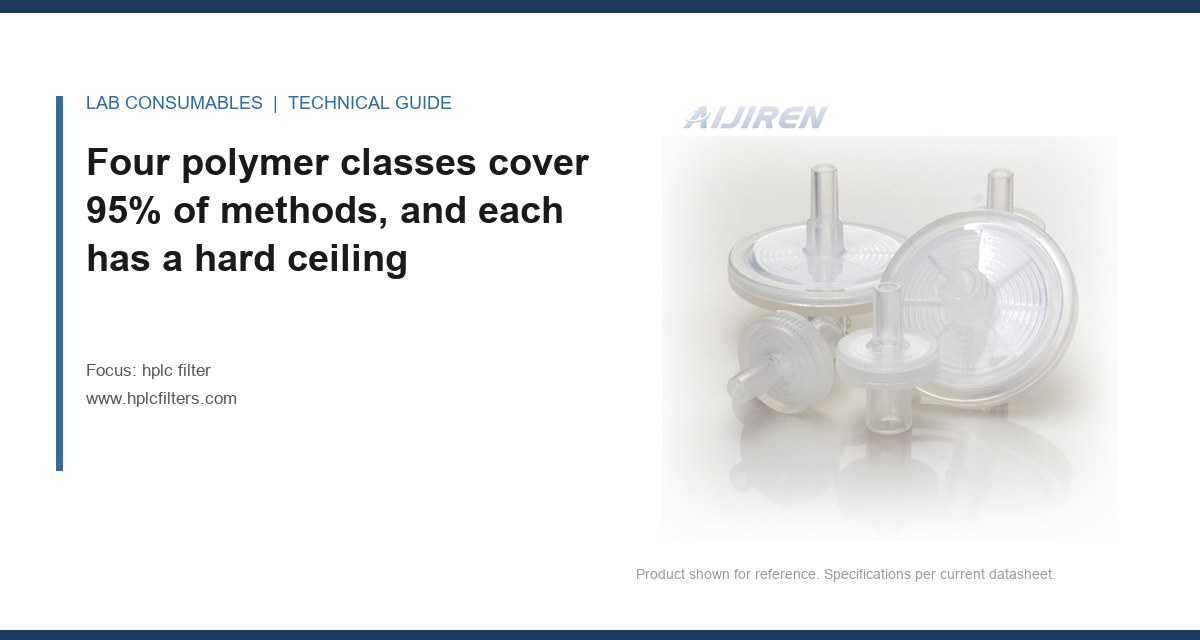
This guide is about which polymer belongs in which method. It assumes you already know what the device does. What it covers is the selection decision: which hplc filter material to use for a given solvent and temperature, what each polymer class does under load, and the specific failure each wrong choice produces so you can recognise it before the column does.
Almost every filter disc or membrane you will specify falls into one of four material families: PTFE, silicone, EPDM, or a laminate (typically PTFE on a polypropylene or polyethylene support). Each has a solvent compatibility envelope, a pH window, and a temperature ceiling. Exceed any of the three and the failure mode is predictable. Below is how I actually specify them, with the numbers I use at the bench.
| Material | Solvent envelope | pH window | Continuous temp ceiling | Typical failure if exceeded |
|---|---|---|---|---|
| PTFE (unsupported) | Near-universal: DCM, THF, DMF, hexane, toluene, strong acids | 0 to 14 | 200 °C (housing-limited in practice) | Cold flow / creep under torque, not chemical attack |
| Silicone | Non-polar and mildly polar; poor in DCM, THF, hexane | 2 to 10 | 180 °C | Swelling in chlorinated solvents; extractables |
| EPDM | Aqueous, alcohol, ketone, dilute acid/base | 1 to 13 | 120 °C | Degradation in aromatic and chlorinated solvents |
| PTFE laminate (on PP/PE) | Broad, but the support sets the limit | 1 to 13 | 90 to 100 °C (support-limited) | Delamination and support dissolution at temperature |
Read that table as a starting filter, not a spec sheet. The support layer is the part that bites you on laminates, and the housing geometry bites you on unsupported PTFE. More on both below.
PTFE is not a universal answer, and the failure is mechanical, not chemical
PTFE gets specified because it is chemically inert, and that reputation is deserved. It survives concentrated sulfuric acid, DCM, THF, and boiling toluene without measurable weight loss. What it does not do is hold its shape under compression. Unsupported PTFE creeps. Put a 25 mm PTFE disc in a screw-together holder, torque it to 15 in-lb, and let it sit at 80 °C for an hour, and the disc thins by 10 to 20 µm at the sealing face. The result is a slow leak at the ferrule seat that shows up as a pressure drop of 3 to 5 bar across a run and an intermittent bubble in the outlet line.
I specify unsupported PTFE for two situations: aggressive organic solvents at ambient temperature, and any method where the solvent list includes something that will dissolve a support layer. For a typical reversed-phase method in acetonitrile or methanol at 40 °C, unsupported PTFE is overkill and the creep risk is real. That is where the PTFE membrane filter in laminate form earns its place: the polypropylene support carries the compressive load so the PTFE layer does not have to.
The one thing to watch on unsupported PTFE is the housing, not the disc. If your holder is a stainless frit with a knife-edge seal, the PTFE will cold-flow into the edge and you will see a ring of extruded polymer after disassembly. That ring is your warning that the torque value is too high for the material. Back it off to 8 to 10 in-lb and re-check for leaks with a 5-minute static pressure hold at 1.5× working pressure.
Silicone belongs in gas paths and nowhere near chlorinated solvents
Silicone has a temperature ceiling of roughly 180 °C and excellent flexibility, which makes it attractive for high-temperature aqueous work. The problem is swelling. Immerse a silicone disc in DCM for 30 minutes and it gains 15 to 25% in mass and volume. In a filter housing, that swelling translates directly to a blocked flow path and a pressure spike. I have seen a 4.6 mm silicone frit swell enough at 50 °C in a 70:30 DCM:methanol mobile phase to raise backpressure from 40 bar to 180 bar over a 20-minute run.
Where silicone is genuinely correct: GC inlet liners, septum seals, and any application where the sample is aqueous or alcoholic and the temperature is above 100 °C. For HPLC mobile phases containing chlorinated solvents, hexane, or THF, silicone is the wrong choice and the failure will be a pressure excursion, not a chromatographic one. If you inherit a method that specifies silicone and you cannot change it, at minimum run a solvent compatibility check: soak a spare disc in the mobile phase at method temperature for 2 hours and weigh it. More than 5% mass gain means the method and the material disagree.
EPDM is the aqueous workhorse, and its pH window is narrower than the label says
EPDM is what most aqueous and dilute-buffer methods should use. It handles pH 1 to 13, tolerates alcohols and ketones, and has a 120 °C continuous ceiling. It is also the cheapest of the four in most formats, which is why it gets over-specified into methods it does not belong in. The failure mode is degradation in aromatic and chlorinated solvents: toluene, xylene, DCM, and chloroform will swell and eventually crumble EPDM, and the crumble shows up as a rising baseline and a filter that sheds particulate into the flow path.
The pH window is the number I see misread most often. The label says 1 to 13, but that is at ambient temperature. At 80 °C, the practical ceiling drops to about pH 11 for continuous service, because the hydrolysis rate of the EPDM backbone roughly doubles every 10 °C. A method running pH 12.5 phosphate buffer at 75 °C will degrade an EPDM filter in about 40 hours of run time. The symptom is a slow rise in extractable UV absorbance at 210 nm and, eventually, visible pitting on the disc face.
For high-pH work above 60 °C, move to PTFE laminate or to a polyethersulfone membrane rated for it. For a typical pH 2 to 8 aqueous method at 30 to 50 °C, EPDM is the right answer and you should stop overthinking it. Where EPDM sits in the sample handling chain matters too: if you are filtering into a COD vial or a similar digestion vessel for a downstream wet chemistry step, the filter extractables become part of the sample, so the material choice is a data integrity decision, not just a hardware one.
Laminate construction moves the failure from the membrane to the support
A PTFE laminate is a PTFE membrane bonded to a polypropylene or polyethylene nonwoven. The membrane handles the chemistry; the support handles the mechanics. The result is a filter with broad solvent compatibility, pH 1 to 13, and a temperature ceiling set entirely by the support. Polypropylene supports cap out around 90 to 100 °C. Polyethylene supports go a little higher, to about 110 °C, but are less common in HPLC formats.
The failure mode that catches people is delamination. Run a laminate at 95 °C in a mobile phase containing 20% THF and the polypropylene support begins to soften and dissolve at the bond line. You will not see it on the first run. You will see it after 30 to 50 injections, when the membrane lifts off the support and the filter starts passing particulate. The tell is a sudden rise in backpressure from a downstream frit that is now loaded with support fibres, and a filter disc that separates cleanly into two layers when you peel it apart after the run.
If your method runs above 85 °C, do not use a laminate unless the manufacturer gives you a support-specific temperature rating in writing. The generic “PTFE, 200 °C” on the box refers to the membrane, not the assembly, and that distinction has cost more labs more columns than any other single spec error. This is the same class of problem covered in the site’s HPLC filter selection material: the datasheet describes a component, the method stresses an assembly.
Three field cases where the material, not the column, was the problem
Case 1: the 60 °C laminate that shed polymer into the vial
A contract lab running a 90:10 ACN:water TFA method at 60 °C saw baseline drift of 0.9 mAU/min and a shoulder at 4.3 min that appeared after 40 injections. The column was replaced twice with no change. The filter was a PTFE laminate with a polypropylene support rated to 90 °C. The method temperature was within the label rating but the mobile phase contained 0.1% TFA, which accelerates polypropylene hydrolysis at temperature. The measurement that identified it: a solvent soak test of a spare disc in mobile phase at 60 °C for 4 hours showed 2.1% mass loss and a UV-absorbing extract at 210 nm. The fix was to switch to unsupported PTFE with a stainless housing, which removed the support from the equation. Drift dropped to 0.05 mAU/min and the shoulder disappeared.
Case 2: the EPDM filter that failed at pH 12.5
A method development group running a high-pH buffer at 75 °C saw a slow rise in backpressure over 40 hours of continuous run time, from 55 bar to 110 bar, and a matching rise in UV absorbance at 210 nm. The filter was EPDM, correctly specified for the aqueous buffer at ambient temperature but not at 75 °C. The measurement: a 72-hour soak of a spare disc in the buffer at 75 °C showed 8% mass loss and visible pitting. The fix was a PTFE laminate with a polyethylene support, rated to 110 °C, which held pressure flat for the full 200-hour test. The lesson: the pH window on the label is an ambient-temperature number.
Decision checklist for the method you are actually running
Work through these in order. The first one that fails tells you the material is wrong, regardless of what the rest of the list says.
- Solvent: Does the mobile phase contain DCM, THF, DMF, hexane, or toluene? If yes, PTFE (unsupported or laminate) is the only safe family. Silicone and EPDM are out.
- pH: Is the method above pH 11 or below pH 2? If yes, PTFE or laminate. EPDM is out above pH 11 at temperature; silicone is out below pH 2.
- Temperature: Is the method above 85 °C? If yes, unsupported PTFE only. Laminate supports fail at the bond line. Above 100 °C, check the housing rating too.
- Extractables sensitivity: Is the detection wavelength below 220 nm? If yes, run a soak test on the candidate material at method temperature for 2 hours and reject anything above 1% mass loss.
- Torque: For unsupported PTFE in a screw-together holder, start at 8 in-lb and verify with a 5-minute static hold at 1.5× working pressure. Do not exceed 12 in-lb.
For reference values on solvent compatibility and temperature ratings, the Restek technical resources and the Agilent consumables documentation both publish material-specific tables that are more reliable than a generic chemical resistance chart. The Thermo Fisher chromatography library is useful for cross-checking laminate support ratings. For methods written under U.S. EPA SW-846, the method text will not name a material, so the selection decision is yours and the documentation burden is yours.
What to do when the method and the material disagree
If the method was validated with a material that is now failing, you have three options and only one of them is good. You can change the material and re-validate, which is correct but expensive. You can reduce the temperature or the solvent strength to bring the method back inside the material’s envelope, which is sometimes possible and always worth checking. Or you can keep running the failing material and manage the symptoms, which is what most labs do and what eventually costs a column. I have never seen the third option work for more than a few hundred injections.
When you do change material, change one variable at a time and re-run the system suitability check. A material change from EPDM to laminate will shift the extractable profile, which can shift a low-wavelength baseline even when the chromatography is unchanged. Run at least 20 blank injections on the new material before you trust a quantitative result. If you are filtering into a vial insert for a low-volume method, check the extractable contribution at the insert volume, not the full vial volume, because the concentration effect is real.
The decision rule
Match the material to the harshest of the three variables in the method, not the average. If the solvent is aggressive, PTFE. If the pH is extreme, PTFE or laminate. If the temperature is above 85 °C, unsupported PTFE with a housing rated for it. If none of those apply and the method is aqueous at moderate pH and temperature, EPDM is correct and cheaper. Silicone belongs in gas paths and high-temperature aqueous work, and nowhere near a chlorinated mobile phase. Verify every material choice with a two-hour soak test at method temperature before you commit a validated method to it, and treat any mass loss above 1% as a rejection. The filter that fails quietly at 60 °C will fail loudly at the column three weeks later.
References & further reading
Related resources from our lab consumables network:
- Hplc Filter at hplcfilters.com
- Ptfe Membrane Filter at ptfemembranefilter.com
- Cod Vial at codvial.com
- Vial Insert at hplcinsert.com
External references and standards: