
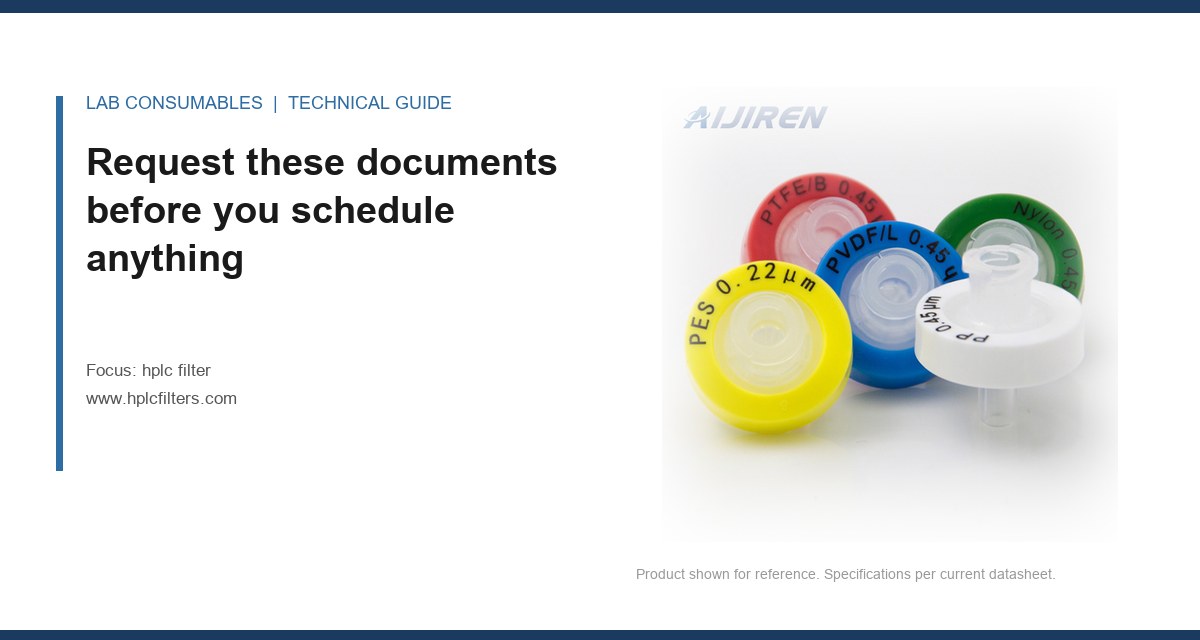
A 0.45 µm PTFE filter lot from a new vendor failed at puncture 34 of 100 on our inline penetration rig, against a purchase spec of 60 minimum. The certificate of analysis said “conforms.” That single number, and the fact that the supplier’s CoA had no test method attached to it, is why I now run every HPLC filter supplier audit checklist from the quality-system side first and the price sheet last. The filter is a $0.60 part that can take a $400 column and a $90 vial of standards down with it, and the audit is the only place you get to see that risk before it reaches your autosampler.
What follows is the checklist I use, in the order I use it, with the evidence I request in advance and the scoring that decides whether a vendor gets a trial order or a rejection letter. It covers the quality-system items that actually predict failures, not the ones that look good in a slide deck. Factory walk-throughs and contract language are separate exercises and I will not repeat them here.
The audit starts with paperwork, and half the vendors you contact will not survive it. I ask for a fixed document packet by email and give a two-week deadline. A supplier that cannot assemble these documents in two weeks has a document control problem, and a document control problem is a batch traceability problem waiting to happen.
- Current ISO 9001 certificate with the certification body named, plus the scope statement. A certificate whose scope covers “distribution of laboratory supplies” tells you nothing about the molding or membrane casting.
- Control of records procedure and a sample batch record for one filter lot, redacted if needed. I want to see whether the operator, the machine, the resin lot, and the membrane roll are all on one page.
- Change notification procedure with the notification window stated in days. If the window is “as appropriate,” score zero.
- Nonconformance and CAPA log for the last 12 months, summarized by defect type. I am looking for the ratio of customer complaints to internal catches, and I want to see at least one CAPA that closed with an effectiveness check.
- Calibration certificates for the instruments that generate the CoA numbers: the tensile tester, the bubble-point rig, the balance, and the leak tester.
- Material declarations for the housing polymer, the membrane, and any adhesive or insert. USP Class VI or SW-846-relevant extractables data if the method is regulated.
Two of these deserve emphasis. The calibration certificates matter because a bubble-point result from an uncalibrated rig is a number with no meaning. The change notification window matters because a silent resin switch is the single most common cause of a filter that passed qualification and then started shedding. I have seen a supplier move from one polypropylene grade to another with a different melt flow index and not tell anyone, and the only symptom was a slow rise in baseline noise across three months.
The quality-system items that predict a bad lot six months out
Most audit checklists are built around what the supplier can show you today. The useful ones are built around what the supplier will do when something goes wrong, because that is when you find out whether the system is real. These are the items I weight heaviest.
Incoming material control on membrane and resin
Ask how the supplier verifies incoming membrane. If the answer is “we trust the membrane manufacturer’s CoA,” you have a supplier who is passing someone else’s risk to you. A serious filter vendor runs at least a bubble-point or a water-flow check on every incoming membrane roll and records the roll ID against the finished lot. The correlation between roll ID and finished lot is what lets them quarantine a bad roll when a customer complaint comes in. Without it, a recall means scrapping everything.
For molded housings, ask for the incoming resin lot record and whether the supplier checks melt flow index. A resin lot with an out-of-spec MFI will mold into a housing with different crystallinity, and a housing with different crystallinity can crack at the thread root under torque. That is a failure that shows up in the field, not on the line.
In-process controls, not just final inspection
Final inspection catches what already went wrong. In-process controls catch drift. I want to see the specific in-process measurements and their frequency: housing dimensions at the start and middle of each shift, weld or bond strength on a sampled basis, and a leak check on 100% of units or a documented AQL sampling plan. If the supplier cannot tell me the sampling plan and the AQL, the “100% inspected” claim is unverifiable.
Ask what the in-process control limits are and who is allowed to adjust them. A line operator who can widen a control limit to keep production moving is a system failure, not an operator failure.
Traceability from lot number back to membrane roll
Pick a lot number off a box in your stock and ask the supplier to walk it back to the membrane roll, the resin lot, the molding machine, the shift, and the operator. If they can do it in under an hour, the traceability chain is real. If they need a day and a phone call, it is a spreadsheet that someone maintains by hand, and hand-maintained traceability breaks under pressure.
Complaint handling and the effectiveness check
The CAPA log is where I spend the most time. I want to see a complaint that was investigated, a root cause that was identified, a corrective action that was implemented, and an effectiveness check that verified the fix. A CAPA that closes with “retrained operator” and no verification is a CAPA that will reopen. Ask for the last three customer complaints and how each one closed. If the answer is vague, the system is vague.
Score the vendor on evidence, not on the tour
I use a weighted scorecard with six categories and a 100-point total. The weights reflect what actually correlates with field failures in my experience, not what is easy to assess.
| Category | Weight | What earns full marks |
|---|---|---|
| Material traceability | 25 | Lot number resolves to membrane roll and resin lot in under one hour; incoming membrane verified per roll |
| In-process controls | 20 | Documented control limits, sampling plan with AQL stated, 100% leak check or justified sampling |
| Change notification | 15 | Written procedure, notification window of 90 days or more, no silent substitution clause |
| CAPA effectiveness | 15 | At least one closed CAPA with an effectiveness check in the last 12 months; complaint log shared |
| Calibration and CoA integrity | 15 | Every CoA test method named, instruments calibrated and in date, test method revision controlled |
| Capacity and lead time | 10 | Stated capacity headroom of 30% or more; lead time variance under 10% over the last four quarters |
A score below 70 means no trial order. Between 70 and 85 means a trial order with a first-article inspection and a 90-day probation. Above 85 means a standard trial order with normal incoming inspection. I do not average the categories into a single number and stop there. A vendor with a 90 total but a zero on change notification is a vendor I will not use, because the one thing that will hurt me most is the thing they do not control.
The scorecard is only as good as the evidence behind it. A supplier who answers “yes” to every question and produces no document gets the same score as a supplier who answers “no” honestly. The audit checklist is a document-collection exercise, not a conversation.
Field cases: what the audit would have caught
Case 1: the puncture count that drifted
A vendor we had used for two years started shipping 0.45 µm PTFE filters that failed at puncture 34 to 41 on our inline rig, against a spec of 60 minimum. The CoA still said “conforms.” The measurement that identified the cause was a housing wall thickness check: the new lot ran 0.08 mm thinner at the thread root than the previous lot. The supplier had changed mold cavities without notification. The fix was a return to the qualified mold and a change notification clause with a 90-day window. The audit item that would have caught it in advance was the in-process dimension record and the change notification procedure. Neither existed. See the PTFE membrane filter page for the membrane-side details that matter here.
Case 2: the baseline that crept up over three months
A different supplier’s filters passed incoming inspection but produced a slow rise in baseline noise on a gradient method, from 0.4 mAU to 2.1 mAU over three months. The measurement that identified it was an extractables screen: a 20 mL flush of acetonitrile through 50 filters showed a UV-active peak at 254 nm that grew with lot number. The root cause was a switch in the membrane rinse solvent at the supplier, from a higher-purity grade to a lower one, with no change notification. The fix was a specification on the rinse solvent and a lot-by-lot extractables check on the first three lots of any new production run. The audit item that would have caught it was the incoming material control record for the rinse solvent, which the supplier did not keep.
Both cases share a pattern: the failure was in a material or a process the supplier did not consider part of the product. The audit checklist exists to force those materials and processes into view.
What to test on the first article, and the numbers to hold
The trial order is where the scorecard gets validated. I run a first-article inspection on three lots before releasing a vendor to standard purchasing. The tests and the numbers I hold are below. These are the ones that have caught real problems, not a generic panel.
- Puncture or penetration resistance: minimum 60 punctures on the inline rig for a 0.45 µm PTFE filter, with a lot-to-lot RSD under 8%. Below 60 means the housing or the membrane support is underbuilt.
- Housing torque at the thread: 0.6 to 0.9 N·m for a standard 1/4-28 threaded filter, with no cracking at 1.2 N·m. A housing that cracks at 1.2 N·m will crack in the field.
- Bubble point: within ±5% of the vendor’s stated value, measured on your rig, not theirs. A wider spread means the membrane pore size is not controlled.
- Extractables: UV absorbance at 254 nm under 0.5 mAU for a 20 mL acetonitrile flush through 50 filters. Above that, ask what the rinse solvent is.
- Leak check: zero failures at 1.5× the rated pressure for 60 seconds on a 30-unit sample.
- Dimensional check: dead volume and fill volume within ±5% of the drawing, measured on 10 units per lot. This is where the autosampler fit lives, and a filter that is 0.1 mm off can core a septum. The vial insert and COD vial dimensions on the same bench are a useful cross-check for the autosampler geometry.
I run these on the first three lots and then on the first lot of every quarter. The quarterly check is not because I distrust the vendor. It is because the failure mode is drift, and drift is invisible on a single lot.
The audit checklist questions that separate a real system from a binder
These are the questions I ask in the audit meeting, in this order, and the answers I am listening for. A supplier who answers all of them with a document reference is a supplier I will score high. A supplier who answers with a story is a supplier I will score low, regardless of how good the story is.
- Show me the last three customer complaints and the CAPA that closed each one. Listening for: a specific root cause and an effectiveness check, not “retrained operator.”
- Show me the change notification procedure and the notification window in days. Listening for: a number of 90 or more, and a list of what counts as a change.
- Show me how a lot number resolves to a membrane roll. Listening for: a system, not a person.
- Show me the calibration certificate for the bubble-point rig. Listening for: a date within the last 12 months and a named calibration lab.
- Show me the in-process control limits and who can change them. Listening for: a quality signature, not a line supervisor.
- Show me the incoming material record for the membrane and the rinse solvent. Listening for: a per-roll or per-lot check, not a supplier CoA on file.
- Show me the last internal audit report and the corrective actions from it. Listening for: findings that were actually fixed.
If a supplier cannot answer four of these seven with a document in hand, the audit is over and the score is capped at 60. That is a hard rule, and it has saved me from two vendors who looked excellent on paper and had no system underneath.
How to weight the score when the evidence is uneven
Most vendors land in the middle, with strong material traceability and weak change notification, or the reverse. The weighting matters more than the total. I weight material traceability and change notification at 40 points combined because those two items predict the failures that reach my bench. In-process controls and CAPA effectiveness are the next 35. Calibration and capacity are the last 25, and a vendor who is weak there but strong on the first two is still usable with a quarterly first-article check.
The one category I do not average is change notification. A zero there is a veto, no matter what the total says. The reason is simple: a supplier who will not tell you when they change a material or a process is a supplier whose other answers you cannot trust, because the thing they are hiding is the thing that will fail.
For the product-side reference points that feed the audit, the HPLC filter pages on this site carry the dimensional and material specifications I use in the first-article panel. For the chromatography side of the same bench, the vendor technical libraries at Agilent, Thermo Fisher, and Restek are where I check whether a stated specification is consistent with how the rest of the flow path is built.
The decision rule is this: score the vendor on documents, not on conversation, and veto any vendor who scores zero on change notification regardless of the total. A vendor at 88 with a 90-day notification window and a per-roll membrane check gets a trial order. A vendor at 92 with a silent substitution clause does not, because the number that will fail is the one they did not tell you about.
References & further reading
Related resources from our lab consumables network:
- Hplc Filter at hplcfilters.com
- Ptfe Membrane Filter at ptfemembranefilter.com
- Cod Vial at codvial.com
- Vial Insert at hplcinsert.com
External references and standards: