
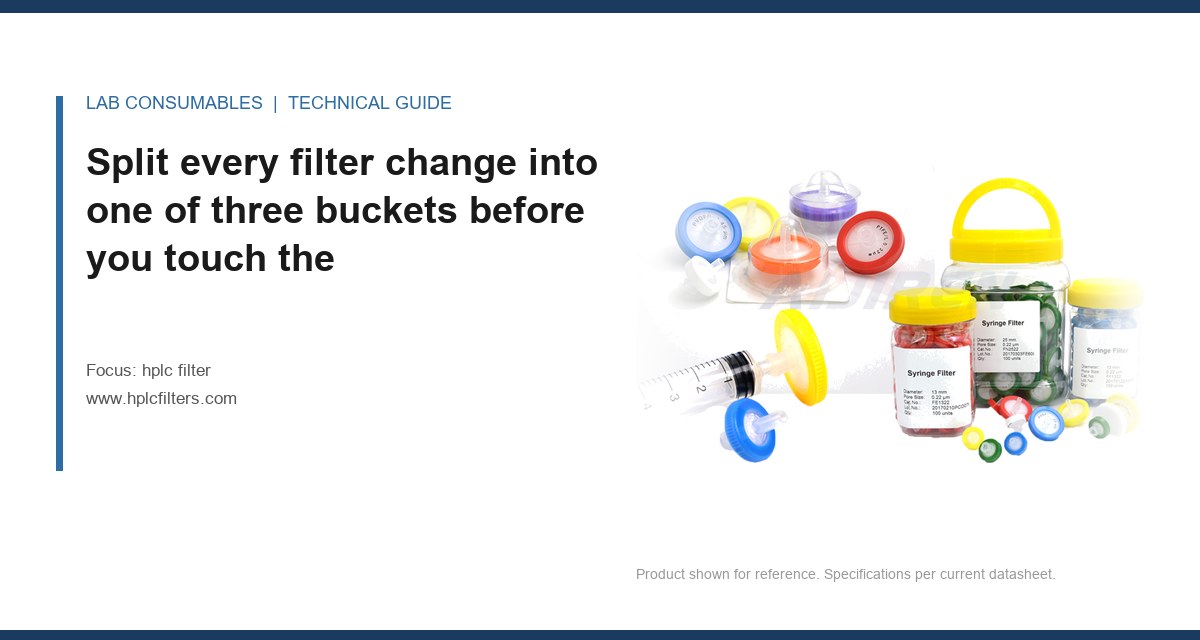
A 0.45 µm PTFE filter lot swap took a validated assay method from 98.6% label claim to 96.9% on the same column, same day, same analyst. The system suitability passed: tailing 1.04, RSD 0.31% across six injections, resolution 2.8. Nothing in the chromatogram looked wrong. The drop was real, it was reproducible, and it sat about 1.7% below the prior lot. That is the situation where revalidation triggers when a hplc filter supplier or lot changes stop being a paperwork exercise and start being a decision about whether your validated method still holds. What follows is how I classify those changes, what I actually measure, and how I write the change-control entry so an inspector reads it once and moves on.
Split every filter change into one of three buckets before you touch the method
Most labs treat every supplier or lot change as either “no action” or “full revalidation.” Both are wrong. The useful split is three-way, and it turns on whether the change touches a critical method parameter or only the supply chain.
Bucket 1: revalidation required
A change lands here when it alters a characteristic the method depends on. That means:
- Membrane chemistry change (e.g., regenerated cellulose to PTFE, or PVDF to nylon). Adsorption profile changes. Extractables change. This is a method change, not a supply change.
- Pore size change (0.22 µm to 0.45 µm, or the reverse). Particulate retention changes, and so does the filter’s hold-up volume and the analyte loss profile for small volumes.
- Diameter change that moves dead volume by more than about 10% on a small-volume injection. A 13 mm filter versus a 4 mm filter is not a like-for-like swap when you are injecting 5 µL.
- Housing material change (polypropylene to HDPE). Extractables and leachables profile changes, and with it the risk of late-eluting baseline artifacts.
- Any change to a filter that sits in the sample path of a method with a validated LOQ below 0.1%, regardless of how minor the change looks on paper.
Bucket 2: verification only
This is where most lot changes belong, and where most labs over-react. A same-supplier, same-part-number lot change with a certificate of analysis that matches the prior lot on the parameters that matter is verification, not revalidation. Verification means you run system suitability plus a bracketed accuracy check against a retained standard, and you document the result. You do not re-run the full validation package.
The parameters that make a lot change “verification only” are: same membrane chemistry, same pore size, same diameter within drawing tolerance, same housing polymer, and a CoA showing extractables within the historical range. If any one of those is missing, it climbs to bucket 1.
Bucket 3: no method action, change-control entry only
Packaging change, carton count change, a supplier moving a molding line without changing resin, a new distributor for the same manufacturer. These need a change-control entry and nothing else. The trap is that bucket 3 changes are exactly the ones people skip documenting, and they are the ones an inspector asks about because the paper trail has a gap.
What actually forces revalidation versus what only needs a verification run
The decision rule I use is a single question: does the change alter a critical method parameter as defined in the method’s own validation report? If yes, revalidate. If no, verify. The method’s validation report should already list which parameters were studied (specificity, linearity, accuracy, precision, LOQ, robustness). The filter’s chemistry, pore size, and diameter are usually buried in the robustness section, if they appear at all. That is the first thing to fix, because a robustness section that does not name the filter gives you nothing to reason from.
Here is the comparison I hand to lab managers when they ask where a change lands:
| Change | Critical parameter touched? | Action | Typical effort |
|---|---|---|---|
| Same part number, new lot, CoA matches | No | Verification: SST + accuracy bracket | 1 analyst-day |
| Same part number, new lot, extractables outside historical range | Yes (robustness) | Revalidation: accuracy, precision, LOQ | 3 to 5 analyst-days |
| New supplier, same chemistry and pore size, drawing matches | Borderline | Verification plus extractables comparison | 2 analyst-days |
| New supplier, different housing polymer | Yes | Revalidation: full accuracy and specificity | 5 to 8 analyst-days |
| Pore size change 0.45 to 0.22 µm | Yes | Revalidation: accuracy, LOQ, recovery | 4 to 6 analyst-days |
| Diameter change 13 mm to 4 mm | Yes (dead volume) | Revalidation: accuracy at low volume | 3 to 4 analyst-days |
| Packaging or carton count | No | Change-control entry only | 30 minutes |
The numbers in the effort column are from our own runs. They will shift with the method, but the ordering does not. A housing polymer change is the expensive one because extractables can show up as late baseline drift that only appears after 40 or 50 injections, which means your verification run has to be long enough to see it.
The verification run has a specific shape, and skipping the bracket is how people get burned
A verification run is not a system suitability injection and a shrug. The shape I insist on:
- System suitability per the method (tailing, resolution, RSD). Six injections minimum, RSD acceptance typically ≤2.0% for assay, ≤5.0% for impurity methods at the LOQ.
- Accuracy bracket: a retained standard or a certified reference material injected before the change and after the change, on the same column, same day. The delta is the number that matters. If the delta exceeds the method’s accuracy acceptance criterion (commonly ±2.0% for assay), you have a revalidation trigger, not a verification pass.
- Extractables screen: a blank filtration through the new lot, injected on the same method, looking for peaks above the method’s reporting threshold. A 0.45 µm PTFE membrane filter run dry-out at elevated temperature will show a different extractables fingerprint than one run at ambient, so match the filtration conditions to the method.
- Recovery check at the low end: spike a known low concentration through the filter and compare to an unfiltered injection. Recovery below 95% at the LOQ is a fail.
The bracket is the part people skip, and it is the only part that catches a slow drift. System suitability can pass beautifully while the accuracy bracket shows a 1.5% shift, because SST measures precision, not accuracy.
Writing the change-control entry so an inspector accepts it on first read
An inspector is not looking for a perfect result. They are looking for a decision that was made deliberately, documented before the change took effect, and supported by data. The entry that survives has five fields, in this order:
1. What changed, stated as a fact, not a category
Not “filter supplier change.” Instead: “HPLC filter, 0.45 µm PTFE, 13 mm, part number X, supplier A lot 2211 replaced by supplier B lot 3304. Membrane chemistry unchanged. Housing polymer changed from polypropylene to HDPE. Drawing dimensions within ±0.10 mm of prior.” The specificity is what lets the inspector see you understood the change.
2. Risk classification with the reasoning
One or two sentences: “Classified as revalidation trigger because the housing polymer change alters the extractables profile, which is a robustness parameter in the validation report (Section 4.6).” If the reasoning cites the validation report by section, the inspector can check it in ten seconds.
3. The verification or revalidation plan, with acceptance criteria written before the run
List the tests and the numeric acceptance criteria. “Accuracy bracket: delta ≤2.0% versus retained standard. Extractables: no peak above 0.05% area in blank filtration. Recovery at LOQ: ≥95%.” Criteria written after the run are worthless and an inspector knows it.
4. The result, with the actual numbers
“Accuracy bracket delta 0.4%. Extractables: no peak above reporting threshold. Recovery at LOQ 97.2%. SST RSD 0.28%.” Numbers, not adjectives.
5. The disposition and the effective date
“New lot released for use effective 2025-03-14. Prior lot retained as reference standard until depletion. Next scheduled review at 12 months or on next supplier change.”
That five-field entry is the whole game. The labs that get cited are the ones where the entry says “filter changed, no impact” with no data and no reasoning. The labs that sail through have the reasoning and the numbers in the same paragraph.
Two field cases where the change-control entry did the work
Case 1: the 1.7% drop that SST could not see
Symptom: Assay method, 0.45 µm PTFE filter, new lot from the same supplier. Result fell from 98.6% to 96.9% label claim, reproducible across three preparations.
Measurement that identified it: The accuracy bracket. A retained standard injected unfiltered read 98.6%; the same standard filtered through the new lot read 96.9%. The delta of 1.7% exceeded the 2.0% criterion only marginally, but the direction was consistent, and a recovery check at the LOQ showed 91.4%, well below the 95% floor. The CoA for the new lot showed a higher extractables value than the prior lot, within the supplier’s own specification but outside our historical range.
Fix: The lot was rejected for this method, the supplier’s extractables specification was tightened in the incoming CoA requirement, and the method’s robustness section was amended to name the filter part number and lot-to-lot extractables limit. The revalidation was scoped to accuracy and LOQ only, not the full package, because chemistry and pore size were unchanged. Three analyst-days.
Case 2: the late-eluting ghost that appeared at injection 47
Symptom: Impurity method, new supplier, same nominal chemistry (0.22 µm PVDF), housing polymer changed to HDPE. First 40 injections clean. At injection 47 a peak appeared at 18.2 minutes, below the reporting threshold individually but above it when integrated across a run.
Measurement that identified it: A blank filtration run extended to 60 injections, plus a solvent blank through the same lot. The ghost tracked the filter, not the sample, and its area grew with cumulative filter exposure. Extractables screen on the housing polymer confirmed the source.
Fix: The verification was reclassified as a revalidation trigger, the supplier was asked for a polypropylene-housing alternative, and the method’s injection count per filter was capped at 40 with a documented rationale. The change-control entry recorded the reclassification and the reason, which is what kept it clean at the next audit.
The supplier documents that make or break the entry
You cannot write a defensible entry without the supplier’s paperwork. Before any change is scheduled, request and file:
- Certificate of analysis for the specific lot, with extractables, pore size, and dimensional data, not a generic spec sheet.
- Material certification for membrane and housing polymers, with the resin grade named.
- Change notification from the supplier, with the date the change was made and the affected lot range. If the supplier cannot provide this, that is itself a finding.
- Extractables data at the method’s filtration temperature, not just ambient. A filter rated to 100 °C behaves differently at 80 °C than at 22 °C.
When you are comparing suppliers, the Agilent consumables documentation and the Thermo Fisher sample handling resources both publish extractables and compatibility data that is useful as a cross-check even when you buy elsewhere. The Restek technical library has comparable data for its filter lines. If a supplier cannot match that level of documentation, the change lands in bucket 1 by default, because you have no basis to classify it lower.
A troubleshooting checklist for when the verification run fails
When the bracket or recovery check fails, work through this in order before you conclude the method is broken:
- Confirm the filter is the variable. Re-run the bracket with the prior lot. If the delta disappears, the filter is the cause. If it persists, look at the column or the mobile phase first.
- Check the filtration temperature. A 10 °C shift changes extractables and adsorption. Match the method’s stated temperature.
- Check the filter wetting and pre-rinse. A dry filter holds up more volume and releases more extractables on first pass. A 1 mL pre-rinse is standard; less than that and you are injecting the filter’s first-pass output.
- Check the housing polymer against the mobile phase. HDPE and polypropylene have different compatibility envelopes. A 100% acetonitrile method and a 60:40 aqueous method will extract different things from the same housing.
- Check the injection volume against the filter dead volume. A 5 µL injection through a 13 mm filter with 30 µL hold-up is mostly filter, not sample. This is where a diameter change bites.
- Check the sample pH. Adsorption onto the membrane changes with pH, and a lot change can shift the surface charge enough to matter at the LOQ.
If all six check out and the bracket still fails, the change is a genuine revalidation trigger and the method’s robustness section needs updating. That is not a failure of the entry. It is the entry doing its job. The consumables you use downstream, including the vial insert and the COD vial, should be held constant during the bracket so you are not chasing two variables at once. For the filter itself, the HPLC filter product line documentation lists the extractables and dimensional data you need to populate the entry.
The decision rule, stated plainly
If the change touches membrane chemistry, pore size, diameter, or housing polymer, revalidate the accuracy, precision, and LOQ sections of the method and cite the validation report section in the change-control entry. If it touches only the lot, the supplier, or the packaging with the chemistry and dimensions unchanged, run a bracketed verification and file the numbers. If it touches neither, write the entry, date it, and move on. The inspector is not grading the size of your validation package. They are checking that the decision was made before the change, the criteria were written before the run, and the numbers are in the record.
References & further reading
Related resources from our lab consumables network:
- Hplc Filter at hplcfilters.com
- Ptfe Membrane Filter at ptfemembranefilter.com
- Cod Vial at codvial.com
- Vial Insert at hplcinsert.com
External references and standards: