
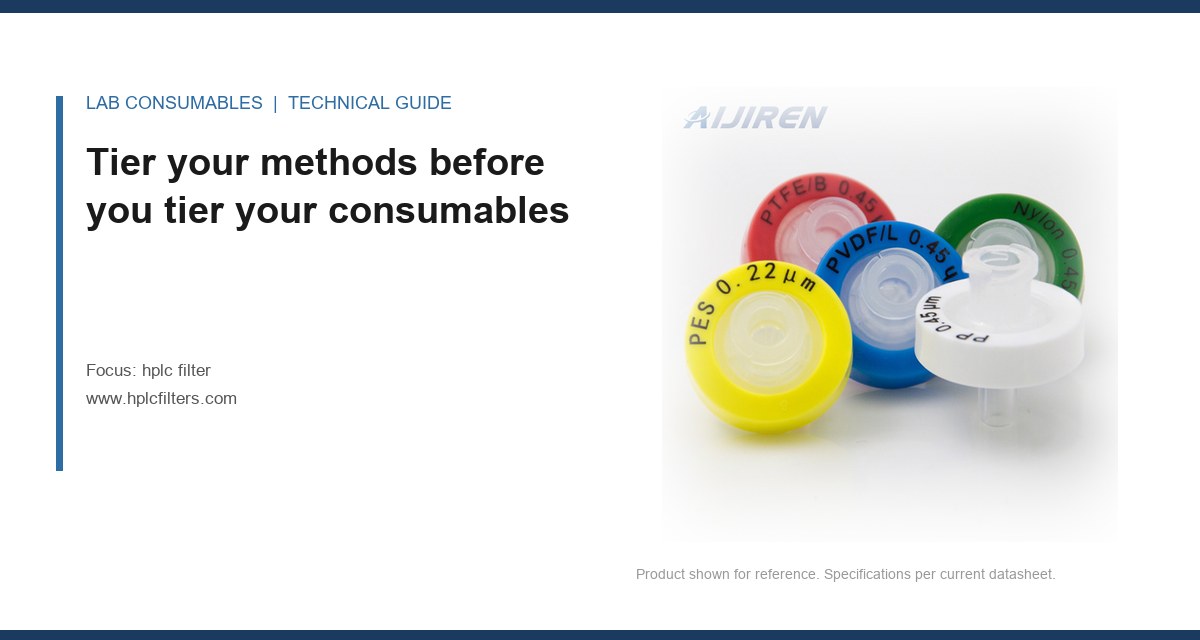
A 0.45 µm PTFE syringe filter that costs $0.38 versus one that costs $1.10 looks like a 65% saving on the purchase order. Then the run fails at injection 340 of a 400-injection validation sequence: a ghost peak at 4.2 minutes, area RSD climbing from 0.6% to 3.1%, and the sequence has to be repeated. That repeat costs more in instrument hours, analyst time, and standards than 5,000 filters. The question is not whether a low-cost HPLC filter is safe in general. It is whether a low-cost filter is safe for the specific method criticality you are running, and that is a tiering decision you can make before you buy.
Most labs I have audited buy filters by price band because they never wrote down which methods can tolerate a bad filter. That is backwards. The filter spec should fall out of the method, not the other way around. I use three tiers, and the tier is set by what a failed result costs, not by how much the method matters to the business.
Tier 1: high criticality
These are methods where a single failed result triggers a repeat, an investigation, or a regulatory finding. Stability-indicating assays, dissolution profiles with tight Q values, bioanalytical runs under a validated method, anything feeding a stability program on a fixed calendar, and any sequence where the reportable result is the mean of a small number of injections. A ghost peak at 0.05% of main peak area fails a related-substances limit of 0.10% once you stack it against an integration threshold. Tier 1 filters need lot-level extractables data, a certificate with the actual membrane lot, and a supplier who will hold a lot for you.
Tier 2: moderate criticality
In-process checks, content uniformity where the spec window is wide, method development, and screening runs. A failed injection here costs one repeat, not an investigation. These methods tolerate more variability, and a mid-priced filter with a certificate of analysis but no extractables study is usually the right call.
Tier 3: low criticality
Presence/absence screening, preparative cleanup ahead of a confirmatory run, and any sample where the filter sits upstream of a dilution that swamps the extractables contribution. This is where the $0.38 filter earns its place, and I will defend that choice.
| Tier | Typical method | Cost of one failed result | Filter spec floor | Acceptable unit price band |
|---|---|---|---|---|
| 1 | Stability-indicating assay, dissolution | $400 to $2,000 (repeat, investigation, standards) | Lot-traceable COA, extractables data, membrane lot on label | $0.90 to $1.60 |
| 2 | In-process check, content uniformity | $80 to $300 | COA per lot, dimensional spec, membrane chemistry stated | $0.50 to $0.90 |
| 3 | Screening, preparative cleanup | $10 to $60 | Membrane chemistry and pore size stated, housing material stated | $0.30 to $0.55 |
Those bands are not arbitrary. They track what the supplier can afford to spend on lot testing and documentation. Below about $0.35 for a 13 mm, 0.45 µm device, the price no longer covers an extractables screen per lot, and you are buying on the supplier’s word.
The failure cost that justifies paying more, line by line
To decide whether the cheap filter is safe for a given method, put a number on the failure. I use four line items, and I add them up before I look at the filter price.
- Instrument time. A 400-injection sequence at 18 minutes per injection is 120 instrument hours. At a loaded cost of $45 per hour, a repeat is $5,400.
- Standards and reagents. A full calibration curve plus system suitability is typically $180 to $400 in reference standards alone.
- Analyst time. Two hours to prepare, run, and review a repeat at $60 per hour loaded is $120, before any investigation.
- Investigation and CAPA. If the failure triggers a lab investigation, budget 8 to 20 hours of senior time. At $90 per hour, that is $720 to $1,800, and it does not include the cost of the delay to the program.
Add the first three and a single repeat is roughly $5,700 to $5,900. Now run the filter math. If a Tier 1 method uses 6,000 filters a year, the difference between $0.38 and $1.10 is $4,320. One prevented repeat pays for the upgrade. That is the whole argument, and it is why I do not entertain “cheap filters are fine” as a blanket position. The arithmetic flips depending on how many filters you burn and how often a failure lands.
The number that matters most is not the unit price difference. It is the failure rate. If the cheap filter fails one sequence in fifty, the expected failure cost per sequence is about $115, and the cheap filter is the false economy. If it fails one in a thousand, the expected cost is $6 per sequence, and the upgrade is the false economy. Most labs have no idea which of those two they are running, which is the actual problem.
What a low-cost filter gives up, and what it does not
Cheap does not mean defective. It means the supplier removed cost from a specific place. Knowing which place tells you whether the removal touches your method.
What usually stays intact
Pore size and membrane chemistry are the first things a supplier gets right, because they are visible on the label and easy to verify. A $0.38 PTFE filter will be 0.45 µm PTFE. The housing will be polypropylene. The luer fittings will work. For Tier 3 work, that is all you need, and I have run screening programs on exactly that for years without a single filter-attributable failure.
What usually gets cut
The cuts land in four places, and each one maps to a failure mode:
- Membrane lot traceability. Cheap filters often carry a date code but not a membrane lot. When a ghost peak appears, you cannot trace it back to a casting run, so you cannot scope the problem. You either scrap the whole case or you run the risk.
- Extractables screening. A full extractables study on a filter costs the supplier several thousand dollars per membrane lot. Below a certain price, it did not happen. For a method with a 0.10% limit, that missing data is the whole risk.
- Housing resin grade. Lower-grade polypropylene can carry mold release agents and slip additives. These show up as late-eluting peaks in reversed-phase runs, often at 1.5 to 2 times the void time, and they get worse as the lot ages.
- Weld and fit tolerance. Loose housing welds leak at the inlet under backpressure, and a slightly undersized membrane can bypass at the edge. Both show up as particulate in the vial, not as a filter failure, which makes them hard to diagnose.
None of these are visible on a datasheet. That is the trap. The datasheet for a $0.38 filter and a $1.10 filter can look identical, because the difference is in what was not measured, not in what was printed.
Where the cheap filter is the right call
I will name the cases where I buy the low-cost filter without hesitation.
Preparative and cleanup work. If the filtrate goes into a dilution of 1:100 or greater before injection, the extractables contribution is diluted by the same factor. A 5 mg/L extractables load becomes 0.05 mg/L, well below any detection threshold that matters. The PTFE membrane filter at the low end of the price band is fine here.
Screening and method development. During development you are changing the method weekly. A filter that adds a small, consistent background is acceptable because you are comparing relative responses, not reporting absolute results. Buy cheap, and spend the savings on more development injections.
High-consumption, low-consequence workflows. Environmental screening where the filter is one of thirty in a batch and the result is a pass/fail against a wide limit. The EPA SW-846 methods are a good example: the filter is not named, the limits are wide, and the cost of a repeat is small.
Any workflow where the filter is downstream of a guard or a pre-column. If the analytical column is protected by a guard cartridge, the failure mode shifts from the column to the guard, and the guard is cheaper to replace than the price difference across a year of filters. I have run this comparison and the guard wins.
Where the cheap filter is a false economy
The false economy cases are narrower than people think, but they are expensive when they hit.
Any method with a related-substances limit below 0.10%. The extractables profile of an unscreened filter can put a peak right at the limit. I have seen a 0.07% peak appear at 11.8 minutes on a cheap filter that was absent on the qualified one. The method passed on the qualified filter and failed on the cheap one, with no change to the sample.
Any sequence longer than about 200 injections. Extractables accumulate on the column head. A filter that contributes 0.5 mg/L per injection looks fine at injection 20 and produces a rising baseline and a drifting retention time by injection 300. The cheap filter is not wrong at the start. It is wrong at the end, which is worse because you have already spent the instrument time.
Any method where the filter is the last thing before the column. No guard, no pre-column, direct injection. The filter’s particulate and extractables load lands on the column. A $1.10 filter is cheaper than a $600 column, every time.
Any regulated submission. If the method is in a filing, the filter is part of the validated method under USP <621>, and you need the lot traceability to defend a change. A filter without a membrane lot on the label cannot support that defense.
One more case that surprises people: methods using a vial insert with a small nominal volume. The insert concentrates whatever the filter sheds into a smaller volume, so the extractables concentration at the needle is higher than the same filter would produce in a standard 2 mL vial. If you are running 150 µL inserts, the filter spec goes up one tier. I have watched a lab chase a “vial problem” for two weeks when the actual cause was a cheap filter feeding a 150 µL insert.
Two field cases that turned on the filter tier
Case 1: the drifting baseline at injection 280
A contract lab running a 350-injection stability sequence saw the baseline rise from 2 mAU to 14 mAU over the run, with retention time drifting 0.04 minutes by the end. The column was new, the mobile phase was fresh, and the sample prep had not changed. The only change was a filter switch to a lower-cost supplier three weeks earlier.
The measurement that identified it: they ran a blank gradient with the filter in line and with it bypassed. The filter-in-line blank showed a rising baseline across the gradient; the bypassed blank was flat. They then extracted five filters from the suspect lot in acetonitrile at 40 °C for 24 hours and found a UV-active species at 254 nm at roughly 3 times the level of the qualified filter. The fix was to return to the qualified filter for Tier 1 methods and keep the cheap filter for the screening bench. The sequence was repeated, and the baseline held at 2 to 3 mAU across 350 injections.
Case 2: the particulate that was not particulate
A pharma QC lab reported intermittent particulate in vials after filtration, appearing in about 1 in 40 vials. They had already blamed the sample and the glassware. The measurement that identified it: they filtered a clean water blank through 20 filters from the lot and counted particles by light obscuration. Six of the 20 filters shed more than 50 particles per mL above 10 µm. A qualified filter from the same supplier shed fewer than 5 per mL. The cause was an edge weld that was not fully consolidated, so membrane fibers escaped at the housing perimeter under the 2.5 bar backpressure the method generated during the final push.
The fix was a lot hold and a return to the qualified filter, plus a change to the SOP: push no harder than 1.5 bar on a 13 mm device. That backpressure ceiling is worth writing down. A 13 mm, 0.45 µm PTFE filter at 1.5 bar is well within spec; at 4 bar it is not, and cheap housings fail first.
A decision checklist you can run in ten minutes
Before you place the next filter order, run the method through these questions. Any “no” pushes the method up a tier.
- Is the reportable result the mean of fewer than six injections? If yes, Tier 1.
- Is the tightest limit in the method below 0.10% (related substances) or a Q value within 5% of the specification? If yes, Tier 1.
- Is the sequence longer than 200 injections? If yes, Tier 1.
- Is there no guard column or pre-column between the filter and the analytical column? If yes, Tier 1.
- Is the filter feeding a vial insert below 200 µL? If yes, Tier 1.
- Is the method part of a regulatory filing? If yes, Tier 1.
- Is the filtrate diluted 1:50 or more before injection? If yes, Tier 3 is acceptable.
- Is the result a pass/fail against a limit at least 10 times the expected extractables contribution? If yes, Tier 3.
- Are you in method development with a method that changes weekly? If yes, Tier 3.
- Does the method generate more than 2 bar backpressure at the filter? If yes, verify the housing rating before buying anything cheap.
For anything in between, Tier 2. That is most methods, and a mid-priced filter with a per-lot COA is the correct answer for most labs most of the time.
What to verify on the cheap filter before you trust it
If you decide the cheap filter is safe for a Tier 2 or Tier 3 method, verify four things before the lot goes into service. This takes about an hour and catches most of the failure modes.
- Run a blank gradient with the filter in line. Compare against a bypassed blank. A rising baseline or a new peak above 1 mAU at 254 nm is a red flag.
- Check the backpressure rating. Most low-cost 13 mm housings are rated to 4 to 6 bar, but the weld is the weak point, not the housing. Hold to 1.5 bar in the SOP unless the supplier provides burst data.
- Particle count a water blank through 10 filters. More than 20 particles per mL above 10 µm is a fail. Qualified filters run under 5.
- Confirm the membrane lot is on the label. If it is not, the filter cannot support a traceability chain, and it belongs on the screening bench only.
For reference points on what a qualified filter should look like on paper, the consumables documentation from Agilent and Thermo Fisher is a reasonable benchmark, and Restek publishes extractables guidance that helps you set your own threshold. The COD vial side of the workflow has the same tiering logic, and it is worth applying the same checklist there.
The decision rule
Buy the cheap filter when the expected failure cost per sequence (failure rate times the cost of a repeat) is less than the price difference per filter times the number of filters per sequence. For most Tier 3 methods that inequality holds by a wide margin, and the cheap filter is the correct engineering choice. For Tier 1 methods it almost never holds, because a repeat costs $5,700 and the price difference across a year of filters is under $5,000. The line between the two is set by the tightest limit in the method, the sequence length, and whether a guard is in the flow path. Write those three numbers down for every method on your bench, and the filter decision stops being a purchasing argument and becomes a calculation.
References & further reading
Related resources from our lab consumables network:
- Hplc Filter at hplcfilters.com
- Ptfe Membrane Filter at ptfemembranefilter.com
- Cod Vial at codvial.com
- Vial Insert at hplcinsert.com
External references and standards: