
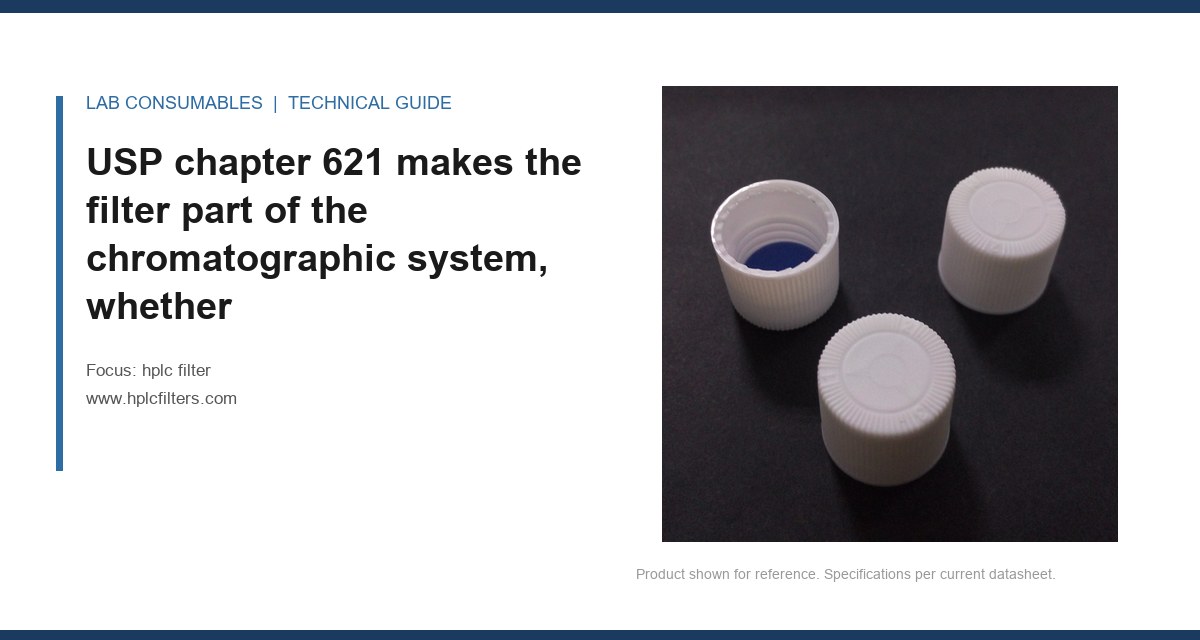
A 2 mL autosampler vial with a PTFE/silicone septum just logged its 47th injection. The method says the closure is good for 50 punctures. Your peak area RSD for the internal standard is 3.8% against a 1.0% system suitability limit, and the needle tip is clean. The problem is not the column, and it is not the pump. It is the filter sitting in the cap. When you run a validated method under USP conditions, the filter is not a generic consumable. It is part of the sample path that USP chapters reach through your method validation, your system suitability, and your documented change control. Understanding the USP requirements for hplc filter in a validated method means reading between the lines of chapters 621, 1058, and 1225, because none of them says “filter” outright. They say the system must be suitable, the method must be validated, and the equipment must be qualified. The filter sits at the intersection of all three.
USP chapter 621 makes the filter part of the chromatographic system, whether the chapter says so or not
USP General Chapter <621> Chromatography defines the chromatographic system as the combination of the instrument, the column, the mobile phase, and the sample introduction device. The filter is not named. That omission has caused more audit findings than it should, because chapter 621 also sets the system suitability parameters you must meet before and during a run. Those parameters include tailing factor, theoretical plates, resolution, and repeatability expressed as RSD. If a filter is shedding particles, adsorbing analyte, or creating a partial blockage that changes the flow profile, those numbers degrade. The chapter does not care where the degradation comes from. It only cares that the system does not meet the acceptance criteria.
I have seen a lab run a 12-hour sequence where the first six injections passed RSD at 0.8% and the last six drifted to 2.4%. The column was fine. The autosampler metering device was fine. The filter in the mobile phase inlet line had accumulated enough fines from a poorly cleaned buffer to create a 12% reduction in flow at the pump head. The pressure trace looked stable because the pump compensated, but the retention times shifted by 0.12 minutes across the sequence. USP 621 does not give you a filter specification. It gives you a system suitability failure that forces you to find the filter.
What 621 actually requires in practice is that every component that touches the sample or mobile phase is controlled well enough to keep the system within the suitability limits you established during method validation. That means the filter must be specified for the method, not selected from a drawer. The specification should include pore size, housing material, membrane material, and the number of injections or volume of mobile phase the filter is qualified for. If you do not have those numbers, you cannot defend the system suitability result when it drifts.
USP 1058 shifts the filter from a supply item to a qualified component
USP General Chapter <1058> Analytical Instrument Qualification is where the filter becomes a formal equipment item. The chapter groups laboratory instruments into three categories: A, B, and C. Most HPLC systems are Group B or C depending on firmware and data handling. The filter is not an instrument, but 1058 requires that any component that affects data quality be included in the qualification scope. A filter that changes the analyte concentration, adds extractables, or alters the flow path is a data-quality component.
The practical consequence is that your filter needs a user requirement specification (URS) and a design qualification (DQ) even if those documents are one page long. The URS should state the pore size, the wetted materials, the pressure rating, and the expected lifetime. The DQ should confirm the supplier’s stated materials match your method’s solvent exposure list. I have written these documents for filters that cost less than two dollars each. The cost of the filter is irrelevant. The cost of an out-of-specification investigation that traces back to an undocumented filter change is usually 20 to 40 hours of analyst and QA time.
One field case from a contract lab: a method using 0.45 µm PTFE syringe filters for sample prep was transferred from a development site to a QC site. The QC site bought a cheaper filter with the same pore size but a polypropylene housing instead of the original polyethylene housing. The method used 80% acetonitrile. Polypropylene is fine with acetonitrile, but the filter housing had a different internal dead volume, and the sample recovery for a low-concentration impurity dropped from 92% to 78%. The investigation took three days. The filter was never named in the method, so the transfer document did not flag it. USP 1058 would have prevented this if the filter had been in the qualification scope with a documented material specification.
USP 1225 and 1226 define what “validated” means for a consumable that is never named
USP General Chapter <1225> Validation of Compendial Procedures lists the validation parameters: accuracy, precision, specificity, detection limit, quantitation limit, linearity, and range. USP <1226> Verification of Compendial Procedures covers the lighter verification path for compendial methods. Neither chapter mentions filters. What they do require is that the procedure you validate produces the same results when run by different analysts, on different days, with different lots of consumables. That last phrase is where the filter enters.
If your method validation used one lot of syringe filters and your routine use pulls from a different lot, you have introduced a variable that was not part of the validation data set. The filter lot can vary in extractable profile, wettability, burst pressure, and particle shedding. A lot-to-lot change in the surfactant used to wet a hydrophilic PTFE membrane can shift recovery for a hydrophobic analyte by 5 to 15%. That shift may not fail your accuracy at the 100% level, but it can fail your low-level linearity point.
The requirement that 1225 places on the filter is indirect but enforceable: the filter must be part of the robustness evaluation. Robustness testing deliberately varies method parameters within small ranges to show the method tolerates normal variation. A filter is a normal variation source. If you did not test two filter lots during robustness, your validation has a gap. I recommend testing at least two lots from the same supplier and one lot from a second supplier if you ever plan to dual-source. The test is simple: run the full system suitability plus a mid-level standard through each filter lot and compare recovery and RSD. If the difference exceeds your intermediate precision limit, the filter is a critical reagent and must be locked to a single supplier and lot-controlled.
The filter specification your method needs but USP does not write for you
USP tells you to qualify and validate. It does not tell you what pore size to use, what membrane chemistry to pick, or how many times you can puncture a septum. Those are method-specific choices, and they are exactly where labs make mistakes that later show up as USP compliance failures. Here is the specification I write for HPLC methods that use syringe filters or inlet filters:
| Parameter | Typical HPLC specification | What happens if you ignore it |
|---|---|---|
| Pore size | 0.45 µm for sample prep, 0.2 µm for UHPLC or column protection | 0.45 µm passes fines that block a 2 µm column frit; 0.2 µm can shear large proteins or slow filtration |
| Membrane material | PTFE for organic-rich samples, regenerated cellulose for aqueous with low protein binding, nylon for broad pH aqueous | PTFE is hydrophobic and will not wet with pure water; nylon binds proteins; cellulose swells in some solvents |
| Housing material | Polypropylene for most HPLC; polyethylene for low extractables with aggressive solvents | Polypropylene can leach oligomers into 100% acetonitrile; polyethylene has lower temperature tolerance |
| Effective filtration area | 3.9 cm² for a 13 mm syringe filter, 4.8 cm² for a 25 mm filter | Smaller area means faster clogging and higher backpressure during manual filtration |
| Hold-up volume | <30 µL for a 13 mm filter, <100 µL for a 25 mm filter | High hold-up volume loses sample volume and shifts low-level quantitation |
| Septum puncture rating | 50 punctures for PTFE/silicone, 100 for pre-slit PTFE/silicone | Beyond the rating, coring sheds particles into the vial and the needle carries septum debris into the injection port |
| Burst pressure | >75 psi for syringe filters, >6000 psi for inline HPLC filters | Below the rating, the filter housing can crack under manual syringe pressure or pump pulsation |
These numbers come from the supplier specifications of the filters we distribute at Hplc Filter and from the PTFE membrane data sheets at Ptfe Membrane Filter. The point is not that these are universal. The point is that your method must have a number for each row, and that number must be defensible against the solvent system and analyte chemistry you run.
Where the filter lives in a USP method’s change control, and why most changes are not “like for like”
Once a method is validated, any change to the filter is a change to the method. USP chapters 1225 and 1226 require that changes be evaluated for their impact on the validated parameters. The common lab practice of substituting a “equivalent” filter from a different supplier is a change control event, not a purchasing decision. The problem is that “equivalent” is not defined by USP, and most procurement comparisons use only pore size and diameter. That is a two-parameter comparison for a component that has at least seven critical parameters.
I have seen a lab replace a 13 mm, 0.45 µm PTFE filter from one supplier with a 13 mm, 0.45 µm PTFE filter from another supplier and lose 30% recovery on a basic analyte. The difference was the PTFE support layer. The original filter used a polypropylene support that did not interact with the analyte. The replacement used a polyester support that adsorbed the protonated amine. Same pore size, same diameter, same membrane polymer. Completely different result. The change control form said “like for like replacement.” It was not.
The decision rule I use is this: if the filter change involves a different membrane polymer, a different support material, a different housing polymer, or a different manufacturing site, it is a major change and requires a bridging study. The bridging study runs the system suitability, a mid-level standard, and a low-level standard through the old and new filter lots. Acceptance is recovery within ±2% of the established mean and RSD within the method’s intermediate precision limit. If the filter change is the same part number from the same supplier but a new lot, it is a minor change and requires only a one-point recovery check. That distinction has kept several of our client labs out of audit trouble.
USP 621 system suitability is the filter’s report card, and the numbers are tighter than most labs realize
System suitability is where the filter’s performance becomes visible. The USP 621 default acceptance criteria for assay methods are RSD ≤ 2.0% for five replicate injections, tailing factor ≤ 2.0, and theoretical plates ≥ 2000 for a typical 150 mm column. Those are defaults. Your method may set tighter limits, and many validated methods do. If your filter is adding a variable that pushes you from 1.2% RSD to 2.1%, you have a system suitability failure that is not the column’s fault.
Here is a field case that fits this exact pattern. A QC lab running a USP monograph method for a small-molecule drug product saw retention time drift of 0.08 minutes over a 20-injection sequence. The column was new. The mobile phase was freshly prepared. The autosampler needle seat was replaced. The RSD for the main peak was 2.3%, just over the 2.0% limit. The investigation found that the inline filter in the pump purge line had a 2 µm stainless steel frit that was partially blocked by buffer salts. The frit had not been replaced in six months because the maintenance schedule did not include it. The fix was replacing the frit and adding a monthly replacement to the instrument qualification checklist. The RSD dropped to 0.9% on the next sequence.
The lesson is that USP 621 does not tell you to replace your inline filter. It tells you that your system must meet the suitability limits. When it does not, the filter is one of the first places to check because it is the cheapest component to replace and the most likely to be neglected. A filter replacement takes five minutes. A column replacement takes 30 minutes and costs 20 times more. The filter is the first diagnostic step, not the last.
Sample prep filters under USP: the difference between a validated step and an unvalidated convenience
When you filter a sample through a syringe filter before injection, that filtration is a sample preparation step. USP 1225 requires that sample preparation steps be validated for accuracy and precision. The filter is part of that step. If you filter standards but not samples, or samples but not standards, you have introduced a bias that the validation must account for. If you filter both, the filter’s recovery for the analyte must be established.
The recovery test is straightforward. Prepare a standard solution at the method’s working concentration. Filter half of it through the filter you intend to use. Inject filtered and unfiltered portions. Calculate the recovery as the filtered peak area divided by the unfiltered peak area times 100. For a quantitative method, recovery should be 98 to 102% for the main analyte and 90 to 110% for low-level impurities. If the filter adsorbs the analyte, recovery drops. If the filter adds extractables that co-elute, recovery appears to increase or a new peak appears.
One case I worked on involved a method for a peptide drug product. The lab filtered the sample through a 0.2 µm nylon filter to remove particulates. The recovery for the peptide was 64%. The investigation showed the nylon membrane was binding the peptide through ionic interactions with the peptide’s charged residues. Switching to a regenerated cellulose membrane with the same pore size brought recovery to 98%. The method had been validated with the nylon filter, so the change required a bridging study and a method revision. The alternative was accepting a 36% loss of analyte, which would have failed the accuracy requirement of 1225 outright.
The inlet filter and the guard column are not the same thing, and USP treats them differently
There is a persistent confusion between the inline HPLC filter and the guard column. The guard column is a chromatography consumable that is part of the column set. The inline filter is a mechanical protection device that sits upstream of the column or the guard. USP 621 treats the guard column as part of the chromatographic system because it affects separation. The inline filter is also part of the system, but it should not affect separation. If it does, it is either clogged or shedding.
The inline filter specification I recommend for most HPLC methods is a 0.5 µm or 2 µm porosity frit in a 316 stainless steel or PEEK housing, with a pressure rating of at least 6000 psi for HPLC and 15000 psi for UHPLC. The frit should be replaced every 500 injections or whenever the system pressure at a constant flow rate increases by more than 10% from the clean-column baseline. That is a concrete, defensible number. If you do not have a replacement interval, you are waiting for a failure.
The Agilent chromatography consumables and columns catalog lists inline filters with these exact pressure ratings, and Thermo Fisher chromatography and sample handling has comparable options. The supplier data is useful because it gives you a documented basis for the pressure rating in your qualification file. USP 1058 expects that documentation to exist.
A troubleshooting checklist that starts with the filter, not the column
When a USP method fails system suitability or shows drift, the filter is the cheapest and fastest component to check. Here is the sequence I use, and it has resolved more investigations than any column replacement:
- Pressure increase over 10% from baseline at constant flow: replace the inline frit and the guard column. If pressure drops after the frit change, the frit was the cause. If not, the guard or column is next.
- Retention time drift with stable pressure: check the mobile phase inlet filter for salt buildup or microbial growth. A blocked inlet filter causes the pump to deliver less than the set flow, and retention times shift.
- Peak area RSD above 2.0% with clean needle and seat: check the vial septum for coring. A cored septum sheds particles into the vial, and the needle picks them up. Replace the closure and consider a pre-slit septum.
- Ghost peaks or baseline noise after a filter change: run a blank through the new filter. Extractables from the filter housing or membrane can elute as peaks. If the blank shows peaks, switch to a low-extractable filter or pre-rinse the filter with mobile phase.
- Low recovery for a specific analyte after a filter change: run the recovery test described above. If recovery is below 95%, the filter membrane or support is adsorbing the analyte. Change the membrane chemistry.
- Clogging during manual sample filtration: the filter is too small for the sample load. A 13 mm filter with 3.9 cm² of area will clog faster than a 25 mm filter with 4.8 cm². Use a larger filter or a pre-filter.
Each of these checks takes less than 15 minutes. The column replacement that most labs jump to takes 30 minutes and may not fix the problem if the filter was the cause. The filter is upstream of the column. It sees the sample and mobile phase first. When something goes wrong, the filter is the first component to show the symptom and the first to rule out.
The USP requirement you will not find in any chapter: a documented filter specification
After 15 years of running chromatography consumables and watching labs pass and fail audits, the single most common USP-related gap I see is the absence of a written filter specification in the method file. The method says “filter the sample through a 0.45 µm PTFE filter” and nothing else. That sentence does not specify the housing material, the filter diameter, the lot qualification, the recovery acceptance, or the replacement interval for the inline frit. USP does not require that level of detail in the monograph, but it does require that your validated method be reproducible. A method that says “0.45 µm PTFE filter” is not reproducible because it allows 20 different products that all meet that description but behave differently.
The fix is a one-page filter specification attached to the method. It should list the supplier part number, the membrane and housing materials, the pore size, the diameter, the hold-up volume, the recovery acceptance range, and the replacement interval for inline filters. It should reference the qualification document that established those numbers. That page takes 30 minutes to write and saves days of investigation when something drifts.
The same logic applies to the vials and closures that sit downstream of the filter. A Cod Vial with a poor septum will undo the work of a good filter, and a Vial Insert with the wrong geometry will change the injection volume. The filter is one link in a chain that runs from the sample vial to the detector. USP compliance is about controlling the whole chain, not any single link.
What the EPA and ISO frameworks do not tell you about USP filter compliance
If you run environmental methods under U.S. EPA SW-846 test methods for waste and materials, you are already familiar with the EPA’s requirement for documented sample preparation and quality control. If you run under an ISO 17025 quality system, you know the requirement for equipment qualification and method validation. Neither of those frameworks adds anything to what USP already requires for the filter. What USP adds is the specific system suitability numbers and the specific validation parameters that the filter must support. The filter is not the star of any of these frameworks, but it is the component that most often causes the numbers to fail.
I have also seen labs use Restek technical resources for chromatography to build filter specifications because Restek publishes detailed compatibility charts and pressure ratings. That is a legitimate approach. The supplier’s technical data becomes part of your DQ, and your in-house recovery test confirms it for your specific analyte and solvent system. The combination of supplier data and in-house verification is what USP expects, even if it never says so in those words.
The decision rule is this: if your method has a filter, the filter has a specification. If the filter has a specification, that specification has a qualification document. If the filter changes, the change has a bridging study. If the system suitability fails, the filter is the first component you check. That rule covers everything USP 621, 1058, 1225, and 1226 require from a consumable that none of them names.
References & further reading
Related resources from our lab consumables network:
- Hplc Filter at hplcfilters.com
- Ptfe Membrane Filter at ptfemembranefilter.com
- Cod Vial at codvial.com
- Vial Insert at hplcinsert.com
External references and standards: