
Last month I pulled a lot of 0.2 µm PTFE syringe filters from a new vendor and ran them against our in-house burst test. The sheet said 75 psi max inlet pressure. Two units failed at 41 psi and 44 psi. When I asked for the test method, the vendor sent a one-line email: “pressure tested per internal SOP.” No gauge class, no ramp rate, no sample size, no temperature. That is when I stopped reading the front of the datasheet and started reading the fine print. If you are buying hplc filter consumables and comparing spec sheets side by side, the first thing you need to know is which numbers on that sheet were actually measured on your lot, and which ones were copied from a design target ten years ago. This guide covers how to read an hplc filter datasheet line by line, which values are tested and which are nominal, and how to spot a sheet that hides its test method.
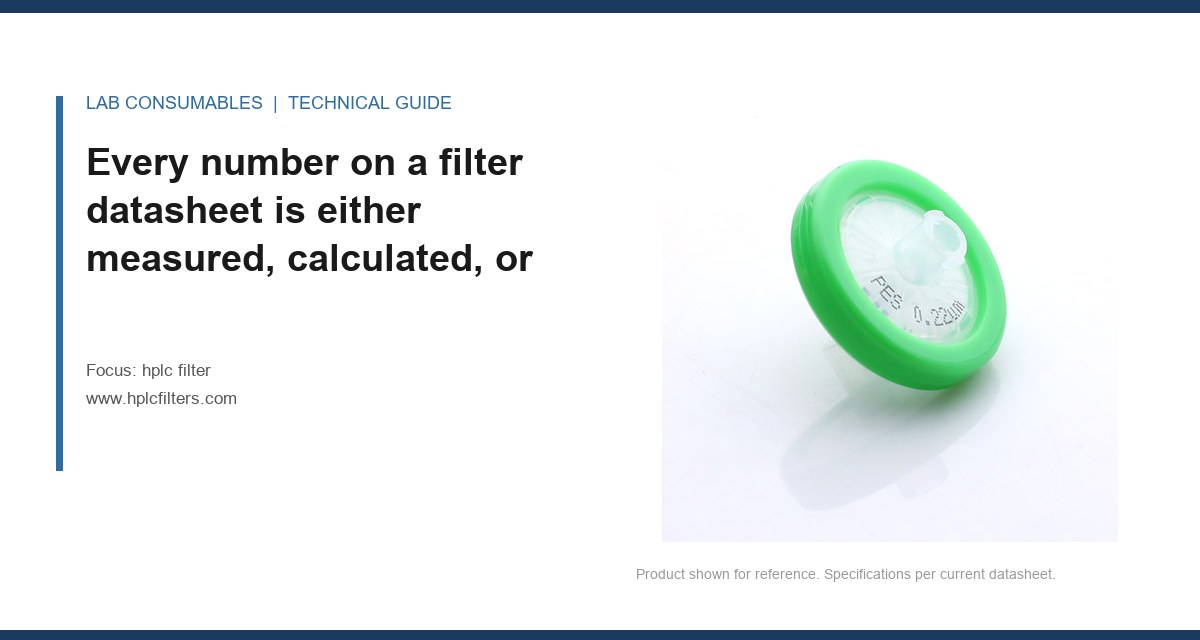
Every number on a filter datasheet is either measured, calculated, or inherited
A filter datasheet is not a single document. It is a stack of three different kinds of values, and most buyers treat all three as equal. They are not.
Measured values come from a physical test performed on finished product, on a defined sample size, using a defined method. Pore size rating, bubble point, extractables, and burst pressure fall into this category when the manufacturer actually runs the test. Calculated values are derived from measured inputs. Flow rate at a given pressure is usually calculated from a measured pressure drop and a measured effective filtration area. Inherited values are the dangerous ones. These are numbers copied forward from a design specification, a raw material certificate, or a competitor’s sheet. Housing dimensions, maximum operating temperature, and sometimes even pore size ratings get inherited. When I audit a new filter supplier, I ask one question for each line item: “What instrument measured this, on how many pieces, and can I see the raw data?” If the answer is a design drawing or a polymer datasheet, I mark that line as nominal.
The practical consequence: two datasheets can list the same 0.45 µm pore size and the same 100 psi pressure rating, yet one filter is tested on every production lot and the other has never seen a pressure gauge. The price difference is not margin. It is the cost of the test.
Pore size rating is the most misread number on the sheet
When a sheet says 0.22 µm or 0.45 µm, most buyers assume the filter removes everything larger than that number. That is wrong. A pore size rating is a statistical statement about retention efficiency under a specific challenge test, not a physical sieve size.
For membrane filters used in HPLC sample prep, the pore size is typically assigned using a bacterial challenge test (for sterilizing-grade membranes) or a particle challenge test (for clarification-grade membranes). A 0.22 µm rated membrane is defined as one that retains Brevundimonas diminuta at a concentration of 10⁷ CFU/cm² with a log reduction value (LRV) of 7 or greater. That is a retention efficiency of 99.99999%, not a physical cutoff. A 0.45 µm membrane is validated against Serratia marcescens. The actual physical pore structure is a tortuous network with a distribution of pore diameters. Some pores are larger than the nominal rating. The rating is a performance claim under a defined test, not a maximum pore diameter.
For HPLC work, the practical difference is this: a 0.45 µm PTFE filter will not remove all particles at 0.45 µm. It will remove a high percentage of them, but sub-visible particles in the 0.2 to 0.5 µm range will pass through in small numbers. If your method is sensitive to particulate fouling of the column inlet frit, use a 0.2 µm filter. If you are filtering a sample that clogs a 0.2 µm membrane too quickly, a 0.45 µm membrane is a legitimate compromise, but you are accepting some particle breakthrough. The datasheet will not tell you this. It will just print the number.
What to check: does the sheet cite a test method? Look for ASTM F838 (bacterial retention), ASTM F316 (bubble point and pore size distribution), or ISO 2942 (bubble point). If the sheet lists a pore size with no method reference, treat it as nominal. A Ptfe Membrane Filter supplier that cannot tell you the challenge organism and LRV for a 0.2 µm rating is selling you a number, not a filter.
Bubble point is the only pore size test you can verify yourself
Bubble point is the pressure at which a wetting liquid is pushed out of the largest pores of a wetted membrane by gas pressure. It is measured in psi or bar, and it correlates inversely with pore size: smaller pores require higher pressure to clear. A 0.2 µm PTFE membrane wetted with isopropanol typically has a bubble point in the range of 13 to 20 psi. A 0.45 µm PTFE membrane runs 7 to 12 psi. A 0.2 µm nylon membrane wetted with water runs 40 to 55 psi because water has a higher surface tension than IPA.
Here is why this matters for a buyer: bubble point is a destructive test in the sense that it wets the membrane, but it is non-destructive to the filter’s structural integrity if done correctly. That means a manufacturer can test every single production lot, and a quality lab can verify incoming lots with a simple pressure rig. If a datasheet lists a bubble point range, that line is almost always a measured value, because it is cheap to test and hard to fake. If a sheet omits bubble point entirely, I get suspicious. A filter manufacturer that does not publish bubble point data is either not testing pore size on finished product, or they are using a pore size rating inherited from the raw membrane supplier.
The test method matters. Bubble point depends on the wetting fluid, the temperature, and the ramp rate of the gas pressure. A sheet that says “bubble point: 15 psi” without specifying the wetting fluid is useless. The same membrane will give different values in water, IPA, or a fluorinated wetting agent. Look for a method reference like ASTM F316 or ISO 4003, and a stated wetting fluid. If the sheet does not name the fluid, ask. If they cannot answer, walk away.
Burst pressure is tested, but only on a sample, and the number is a minimum
Burst pressure is the inlet pressure at which the filter housing or membrane ruptures. For a 13 mm or 25 mm syringe filter with a polypropylene housing, a typical published burst rating is 75 to 100 psi. For a 4 mm or 13 mm filter with a reinforced housing, you may see 150 psi or higher. For inline HPLC solvent filters with stainless steel or PEEK housings, burst ratings can exceed 500 psi.
This number is a measured value, but it is measured on a sample, not on every unit. A manufacturer will pull a defined number of filters from each lot, mount them on a test manifold, and ramp pressure until failure. The published number is usually a minimum with a safety margin below the actual mean failure pressure. If the sheet says 75 psi, the lot probably failed at 90 to 110 psi on average, and the manufacturer set the rating low enough to cover lot-to-lot variation.
The problem is the method. Burst pressure depends on the pressure ramp rate, the temperature, the fluid (air vs. water), and the fixture. A filter tested with a slow air ramp at 20°C will give a different number than one tested with a fast water ramp at 40°C. When my lot failed at 41 psi against a 75 psi rating, the vendor’s “internal SOP” was the problem. A proper datasheet will cite a method, or at minimum state the test fluid and ramp rate. If it does not, the burst pressure is a nominal value with a tested-sounding number attached.
For HPLC work, the burst pressure rating is less about what the filter survives and more about what the operator can apply. A manual syringe can generate 100 to 150 psi at the plunger. An autosampler with a pressurized vial can push 50 to 80 psi through a filter. If your filter burst rating is 75 psi and your autosampler runs at 70 psi, you have no margin. Check the rating against your actual system pressure, not against the column backpressure. The filter sees the full upstream pressure.
Extractables data is the line that separates real HPLC filters from impostors
Extractables are compounds that leach out of the filter into the sample or mobile phase under defined conditions. For HPLC, this is the specification that matters most for method integrity, and it is the one most often missing or fudged on datasheets.
A real extractables test runs the filter with a defined solvent (usually methanol, acetonitrile, or water), at a defined temperature and time, and then analyzes the extract by HPLC, GC-MS, or LC-MS. The result is reported as total extractable mass per filter, or as a chromatographic profile showing no peaks above a detection threshold. For a clean PTFE filter, a good extractables spec is less than 0.1 mg per filter in methanol. For a nylon or PVDF filter, you may see 0.2 to 0.5 mg per filter. For a filter with a polypropylene housing and no pre-washing, you can see 1 mg or more of oligomers and processing aids.
The trap is the phrase “low extractables” with no number. That is a marketing claim, not a specification. Another trap is extractables data run in water only. Water is the least aggressive solvent. Most HPLC methods use acetonitrile or methanol, which extract more. A sheet that reports water extractables only is hiding the number that matters for your mobile phase.
When I evaluate a filter for a method with a UV detector at 210 nm or lower, I ask for the extractables profile in the exact mobile phase solvent, run on the same detector wavelength. If the vendor cannot provide it, I run the test myself: filter 10 mL of mobile phase through the filter, inject the filtrate, and look for ghost peaks. A filter that adds peaks at 210 nm is unusable for low-wavelength methods, regardless of what the datasheet says. The Thermo Fisher chromatography and sample handling catalog lists extractables data for their certified filters, and it is worth comparing their method to your vendor’s method. If the methods differ, the numbers are not comparable.
Flow rate and throughput are calculated values, not measured guarantees
A filter datasheet will often list a flow rate, something like “flow rate: 100 mL/min at 10 psi for water.” That number is calculated from the membrane’s water permeability and the effective filtration area. It is not a guaranteed throughput for your sample.
The calculation works like this: the manufacturer measures clean water flow through a membrane disc at a defined pressure, divides by the membrane area, and multiplies by the effective area of the finished filter. That gives a theoretical clean water flow rate. Your sample is not clean water. If you are filtering a plasma sample, a soil extract, or a dissolved tablet, the actual flow rate will be 10 to 50% of the clean water number, and it will decay as the membrane loads with particles.
Throughput, the total volume you can filter before the membrane clogs, is even more variable. It depends on the particle load, the particle size distribution, the viscosity, and the surface tension of your sample. No datasheet can guarantee throughput for a real sample. A sheet that lists “throughput: 50 mL” is giving you a nominal value based on a specific challenge test, usually a defined concentration of a standard test dust. Your sample will be different.
What to use instead: ask for the effective filtration area (EFA) in cm². A 13 mm syringe filter typically has an EFA of 0.6 to 0.8 cm². A 25 mm filter has 3.5 to 4.5 cm². A 33 mm filter has 6 to 7 cm². Larger EFA means more throughput for the same pore size and membrane type. If your samples clog a 13 mm filter, moving to a 25 mm filter with the same membrane gives you roughly 5x the area and 5x the throughput. That is a concrete number you can use for selection, and it is on the sheet if you know to look for it.
Housing dimensions are inherited values, and that is usually fine
The physical dimensions of an HPLC filter housing, the inlet and outlet configuration, the diameter, the length, are inherited from the mold drawing. They are not re-measured on every lot, and they do not need to be. A 13 mm filter with a female Luer lock inlet and a male slip Luer outlet has those dimensions by design. The mold defines them.
What can drift is the fit tolerance. A Luer lock connection is defined by ISO 594 (now superseded by ISO 80369-7), which specifies the thread dimensions and taper angle. A filter housing molded from polypropylene will shrink slightly after molding. If the mold is not compensated correctly, the Luer taper can be off by a few thousandths of an inch, and the filter will leak or pop off under pressure. This is a real failure mode I have seen: a batch of filters that looked identical to the previous batch but leaked at the Luer connection because the mold temperature drifted and the taper angle changed.
The datasheet will not tell you this. It will list the nominal dimensions and the connection type. The only way to verify Luer fit is to test a sample against a gauge pin set or against your actual syringes and autosampler needles. If you are buying for an autosampler, the filter must seal against the needle port at the system’s operating pressure. A Vial Insert has a similar fit tolerance issue: the insert must seat correctly in the vial, and a few thousandths of an inch matters. The same principle applies to the filter-to-vial interface.
Temperature ratings are inherited from the polymer, not tested on the finished filter
A datasheet will list a maximum operating temperature, often 100°C for polypropylene, 180°C for PTFE, or 121°C for autoclavable filters. These numbers are inherited from the polymer’s heat deflection temperature or continuous use temperature, not measured on the assembled filter.
This matters because the filter is a composite. The membrane may be PTFE, but the housing is polypropylene. The housing will soften and deform long before the membrane fails. A PTFE membrane filter in a polypropylene housing is not a 180°C filter. It is a 100°C filter because the housing sets the limit. If you need to filter hot solvents, you need a filter with a housing rated for that temperature, or a stainless steel inline filter.
The other temperature issue is autoclaving. A filter rated for 121°C autoclaving must survive steam at 15 psi for 15 to 20 minutes without the housing warping or the membrane detaching. This is a testable claim, and a manufacturer that publishes an autoclave rating has usually tested it. But the number of autoclave cycles matters. A polypropylene filter may survive one cycle but deform after five. If your protocol calls for repeated autoclaving, ask for the cycle rating, not just the temperature.
For most HPLC work, temperature is not the limiting factor. The filter sits at room temperature in the autosampler or on the solvent line. But if you are doing high-temperature GPC or filtering hot extracts, the inherited temperature number becomes a real constraint.
The test method citation is the single most important line on the sheet
Every specification on a filter datasheet should trace back to a test method. The method may be an ASTM, ISO, USP, or an internal SOP. The difference is verifiability.
ASTM F838 for bacterial retention, ASTM F316 for pore size by bubble point, ISO 2942 for bubble point, ISO 10993 for biocompatibility, USP <88> for biological reactivity. These are public methods with defined procedures, equipment, and acceptance criteria. If a sheet cites them, you can reproduce the test or audit the results. If a sheet cites “internal SOP” with no method number, you cannot.
An internal SOP is not automatically bad. Every manufacturer has internal methods for things like housing dimensions or visual inspection. But for critical performance specs, pore size, burst pressure, extractables, the method should be public or at minimum fully documented and available for audit. When I asked the vendor from my opening story for their burst test method and got a one-line email, that was the end of the evaluation. A supplier that cannot produce a test method for a published spec is not a supplier you can qualify.
The Restek technical resources for chromatography library has good reference material on filter selection and method validation. Compare their documentation style to a no-name vendor’s sheet. The difference in method transparency is immediately obvious.
Which numbers you can verify in your own lab, and which you cannot
Here is a practical table for an incoming QC check. It tells you what to test, what to ask for, and what to accept on faith.
| Spec on datasheet | Tested or nominal? | Can you verify in-house? | What to ask the vendor |
|---|---|---|---|
| Pore size rating | Tested if method cited | Indirectly, via bubble point | Challenge organism, LRV, method reference |
| Bubble point | Tested on finished product | Yes, with a pressure rig and wetting fluid | Wetting fluid, temperature, ramp rate |
| Burst pressure | Tested on a sample | Yes, with a burst test manifold | Sample size, fluid, ramp rate |
| Extractables | Tested if a number is given | Yes, with HPLC or LC-MS | Solvent, temperature, time, detection wavelength |
| Flow rate | Calculated | Yes, but only for clean water | EFA, test fluid, pressure |
| Throughput | Nominal, challenge-specific | Only for your sample | Challenge particle, concentration, endpoint |
| Housing dimensions | Inherited from mold | Yes, with gauge pins | Mold drawing, tolerance class |
| Temperature rating | Inherited from polymer | Yes, with a controlled oven test | Which component sets the limit |
| Autoclave cycles | Tested if a cycle count is given | Yes, with repeated autoclave runs | Cycle count, pressure, time |
The pattern is simple: anything with a method reference and a number is probably tested. Anything with a number and no method is nominal. Anything with an adjective and no number is marketing.
Two field cases where reading the datasheet wrong cost real money
Case 1: the ghost peak that was not a ghost. A pharmaceutical QC lab switched to a lower-cost 0.45 µm nylon filter for a dissolution method with UV detection at 214 nm. The method had been running clean for years with a PTFE filter. Within a week, the lab saw a new peak at 2.3 minutes in the blank. The analyst spent two days chasing the column, the mobile phase, and the autosampler. The fix was simple: the nylon filter was leaching a processing aid into the acetonitrile-water mobile phase. The datasheet said “low extractables” but gave no number and no solvent. The old PTFE filter had an extractables spec of less than 0.05 mg per filter in methanol. The new filter had no extractables data at all. The lab switched back and wrote a new purchasing spec: no filter without a solvent-specific extractables number.
Case 2: the burst pressure that was not a burst pressure. An environmental lab running U.S. EPA SW-846 test methods for semi-volatiles was filtering soil extracts through 25 mm PTFE filters. The datasheet said 100 psi burst pressure. The lab’s automated extraction system pushed the extract through the filter at 85 psi. Filters started splitting at the housing seam after about 20 samples per lot. The failure was not a burst in the traditional sense. It was a fatigue failure at the ultrasonic weld seam, driven by pressure cycling. The datasheet’s burst pressure was a single-ramp test to failure. It did not account for repeated pressure cycles. The fix was a filter with a higher burst rating and a documented weld strength test. The new spec required a minimum burst pressure of 150 psi and a weld seam test per ASTM F2054 (burst test for flexible packaging seals, adapted for filter housings).
What a complete HPLC filter datasheet should contain
If I am writing a purchasing spec for Hplc Filter consumables, here is the minimum I require from every vendor before I will qualify the product:
- Pore size with a method reference (ASTM F838 or F316) and a stated challenge organism or bubble point fluid
- Bubble point with wetting fluid, temperature, and acceptable range
- Burst pressure with test fluid, ramp rate, and sample size
- Extractables in at least one organic solvent, with a number, not an adjective
- Effective filtration area in cm²
- Housing material and membrane material with the temperature limit set by the lowest-rated component
- Luer or connection type with the applicable ISO standard
- Lot traceability with a certificate of analysis available for each lot
Anything less than this is a partial datasheet. You can still buy the filter, but you are buying it on faith, and faith is not a specification.
Decision rule for reading any HPLC filter datasheet
When you pick up a filter datasheet, do not read it top to bottom. Read it in this order: find the test method citations first. If there are none, every number on the sheet is nominal. Then check the extractables line. If it says “low” without a number, the filter is not qualified for HPLC work. Then check the bubble point. If it is missing, the pore size rating is inherited from the membrane supplier, not verified on finished product. Then check the burst pressure against your actual system pressure, with a safety factor of at least 1.5x. If your autosampler runs at 70 psi, you need a filter rated for 105 psi minimum, not 75 psi. Then check the EFA. If your samples clog, buy more area, not a smaller pore size. And if the vendor cannot produce a test method for a published spec, the spec does not exist. That is the whole decision rule. It works every time, and it has saved me from buying filters that were only numbers on a page.
References & further reading
Related resources from our lab consumables network:
- Hplc Filter at hplcfilters.com
- Ptfe Membrane Filter at ptfemembranefilter.com
- Cod Vial at codvial.com
- Vial Insert at hplcinsert.com
External references and standards: