
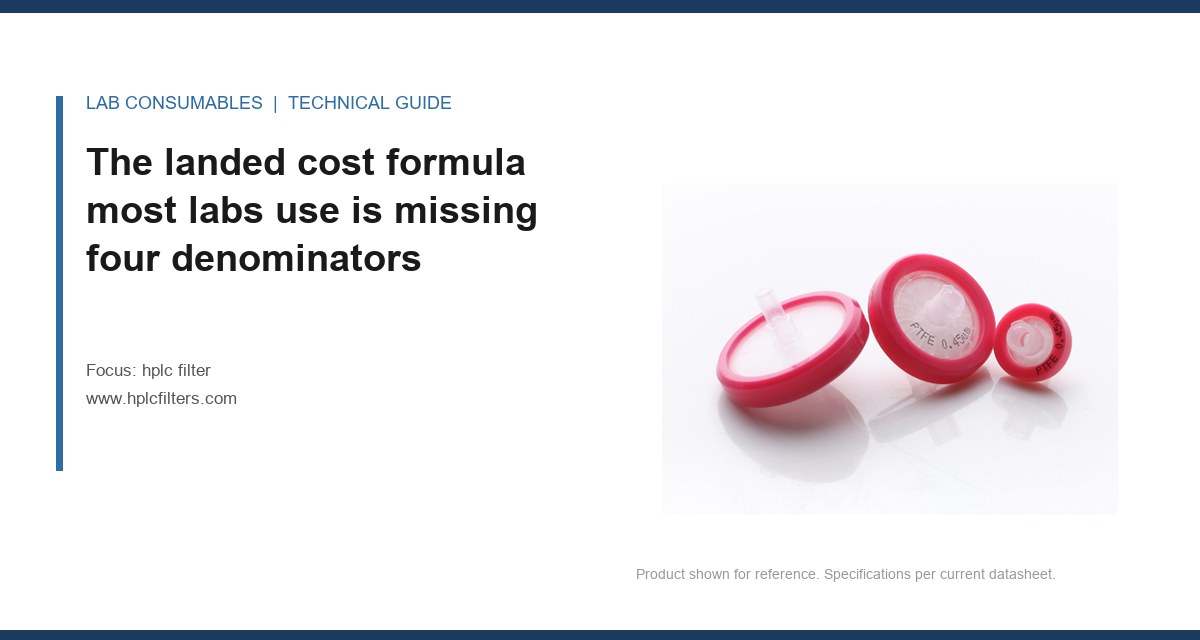
A 47 mm PTFE filter with a 0.45 µm pore size costs $1.12 per piece on the quote. That number is the first of about fourteen that actually determines what the filter costs by the time it sits in an autosampler vial, survives a 400-bar gradient run, and gets thrown into a sharps container. I have watched procurement teams sign off on that $1.12 figure and then discover six months later that the true cost per usable unit was $2.31. The gap was not fraud. It was freight, duty, inspection, storage, and failure cost that nobody put on the purchase order. This article is about building an hplc filter landed cost calculation that includes those buckets, with a worked example you can copy into a spreadsheet.
Ask a lab manager what a filter costs and they will quote the invoice line. Ask a procurement manager and they might add freight and duty. Both numbers are wrong in the same way: they divide total spend by units ordered, not by units that actually enter a method and pass. A landed cost calculation that stops at the receiving dock ignores what happens between the dock and the data file.
The full denominator is usable units, not shipped units. A lot of 1,000 filters that arrives with 12 crushed frits, 8 units that fail a bubble point spot check, and 6 that get dropped during repackaging has 974 usable units. If the purchase price was $1.12 per unit, freight added $0.09, duty added $0.04, and inspection labor added $0.11, the naive landed cost is $1.36. Divide the total spend of $1,360 by 974 and the real cost per usable unit is $1.40. That is before a single filter fails in a run.
I have run this math on lots from three different manufacturers. The spread between the naive cost and the usable-unit cost ranges from 3% to 18%, and the spread is never visible on a quote comparison sheet. The filter with the lowest unit price often has the highest usable-unit cost because its failure rate and inspection burden are higher. That is the first lesson: landed cost is a rate, not a sum, and the rate depends on what you put in the denominator.
Freight is a fixed cost that punishes small orders and air shipments
Most HPLC filter orders are small. A lab running 40 samples per day might go through 120 filters per month across mobile phase preparation and sample prep. That is a box, not a pallet. Freight on a box from a US distributor is $18 to $35 ground, or $60 to $120 for a next-day air shipment. On a 500-unit order, that is $0.04 to $0.24 per unit. On a 100-unit emergency order, it is $0.18 to $1.20 per unit.
The fix is not always to order more. Filters have a shelf life, and PTFE membrane filters stored in a humid stockroom can adsorb moisture that changes retention times for polar analytes. I have seen a lab order 2,000 filters to amortize freight and then throw away 600 of them eighteen months later because the lot drifted in a stability study. The freight savings was $0.11 per unit. The waste was $0.67 per unit. Landed cost calculation must include the cost of money tied up in inventory and the cost of obsolescence, not just the freight line.
Duty is the second bucket that gets ignored until the customs broker calls. In the US, most HPLC filters are classified under HTS 8421.29.0065 or 3926.90.9990 depending on whether the filter housing is metal or polymer. The duty rate is usually 0% to 4.2%, but the classification determines whether you pay it at all. A filter classified as a laboratory plastic article can be duty-free, while the same filter classified as a filtration device can carry a 3.5% duty. The difference on a $5,000 order is $175. That is real money, and it belongs in the landed cost model before you commit to a supplier in a different country.
I have also seen customs brokers hold a shipment for five days over a missing country-of-origin certificate. The holding cost is not a line item on any invoice, but the lab that runs out of filters and pays $85 for a same-day courier from a local distributor has just added $0.17 per unit to the annual average. Landed cost includes the cost of the stockout you cause by not planning for customs variability.
Inspection cost is the bucket that scales with supplier quality, not order size
Every filter lot should be inspected before it enters the lab inventory. The inspection is not optional, and it is not free. A competent incoming QC check for an HPLC filter takes 45 to 90 minutes of a technician’s time. That includes visual inspection for crushed frits, a bubble point test on a sample of 5 to 10 units, and a dimensional check on the housing OD and thread form. At a loaded labor rate of $45 per hour, that is $34 to $68 per lot. On a 500-unit lot, that is $0.07 to $0.14 per unit. On a 100-unit lot, it is $0.34 to $0.68 per unit.
The inspection cost is not fixed. A supplier with a history of 2% defect rates forces you to inspect more units to catch the defects. A supplier with a 0.2% defect rate lets you use a smaller sample size for the same confidence level. The AQL number you pick on the purchase order determines how many units you inspect, and that number should be driven by the failure cost, not by habit. A filter that fails in a dissolution bath costs $200 in rerun time. A filter that fails in a sample prep step costs $15. You inspect more for the first application.
I have a client who buys 47 mm PTFE filters for a USP dissolution method. They inspect 32 units per lot using an AQL of 1.0. The inspection takes two hours because they do a bubble point on each unit in a custom jig. The inspection cost is $90 per lot. On a 1,000-unit lot, that is $0.09 per unit. They tried to skip inspection for two lots from a new supplier. The third lot had a 4% defect rate that caused three dissolution runs to fail. The rerun cost was $600. The inspection would have cost $180 for those three lots. The landed cost model now includes inspection as a mandatory line, and the supplier’s quote is adjusted upward by the inspection burden before any comparison is made.
Storage cost is not zero, and it is not linear
A box of filters on a shelf looks free. It is not. The shelf occupies space in a stockroom that has a cost per square foot. The filters tie up working capital. The filters age. The filters can be damaged by temperature cycling, humidity, or a technician knocking the box onto the floor.
The storage cost per unit is small: $0.01 to $0.05 per month for a typical lab. The problem is that storage cost compounds when you over-order to hit a volume discount or amortize freight. A lab that orders 12 months of inventory to get a 10% price break saves $0.11 per unit on the purchase price and then spends $0.12 to $0.60 per unit on storage and obsolescence over that year. The break-even point depends on the cost of capital, the shelf life, and the failure rate of the specific filter.
PTFE membrane filters have a typical manufacturer shelf life of 3 to 5 years from the date of manufacture, not from the date of purchase. If a distributor has been holding the stock for 18 months, you receive filters with 18 months of shelf life already gone. The landed cost calculation should include the remaining shelf life as a discount factor. A filter with 12 months of shelf life left is not worth the same as a filter with 60 months left, because the probability of a stability failure or a QC rejection rises as the membrane ages.
I have measured the effect. A lab stored 47 mm PTFE filters in a stockroom that cycled between 18°C and 28°C daily. After 14 months, the bubble point on the stored filters was 12% lower than on a fresh lot from the same manufacturer. The filters still passed the nominal spec, but the retention time reproducibility on a polar analyte method degraded from 0.8% RSD to 1.6% RSD. The storage conditions, not the filter itself, caused the method drift. The landed cost of that drift was two weeks of investigation time and a method revalidation. That cost never appeared on any purchase order.
Failure cost is the denominator that makes or breaks the model
The most expensive filter is the one that fails during a run. The failure cost depends on where the filter sits in the workflow. A mobile phase filter that fails at 400 bar can send particulate into the column and destroy a $900 analytical column. A sample prep filter that fails can cause a syringe to clog, a run to abort, and a sample to be lost. A filter in a dissolution bath that fails can invalidate a dissolution profile for an entire batch.
I use a simple failure cost table when I build a landed cost model:
| Failure location | Failure mode | Cost per failure | Typical failure rate | Expected cost per filter |
|---|---|---|---|---|
| Mobile phase filtration, 47 mm disc | Burst at 400 bar | $900 column + $150 rerun | 0.1% to 0.5% | $1.05 to $5.25 |
| Sample prep, 13 mm syringe filter | Clog before full volume filtered | $15 rerun + $8 consumables | 0.5% to 2.0% | $0.12 to $0.46 |
| Dissolution sampling, 10 µm cannula filter | Leak at cannula connection | $200 rerun + $80 analyst time | 0.2% to 1.0% | $0.56 to $2.80 |
| Autosampler inlet, 0.5 µm frit | Shedding particles into flow path | $400 column + $100 downtime | 0.05% to 0.2% | $0.25 to $1.00 |
The expected cost per filter is the failure rate multiplied by the cost per failure. For a mobile phase filter with a 0.3% burst rate and a $1,050 failure cost, the expected failure cost is $3.15 per filter. That is three times the purchase price. The filter with a $0.89 unit price and a 0.5% burst rate has an expected failure cost of $5.25 per filter. The filter with a $1.12 unit price and a 0.1% burst rate has an expected failure cost of $1.05 per filter. The cheaper filter is $3.15 more expensive per usable unit when failure cost is included.
This is why I tell procurement managers to stop comparing unit prices. Compare the landed cost per usable unit, which is the sum of purchase price, freight, duty, inspection, storage, and expected failure cost, divided by the number of units that actually survive to do their job. The formula is:
Landed cost per usable unit = (Total purchase cost + freight + duty + inspection labor + storage cost + expected failure cost) / (Units ordered × (1 − defect rate) × (1 − in-use failure rate))
A worked example: turning $1.12 into $2.31
Let me walk through a real calculation for a 1,000-unit order of 47 mm PTFE filters with a 0.45 µm pore size, purchased for a USP dissolution method. The supplier quote is $1.12 per unit. Freight is $42 for a ground shipment from the distributor. Duty is 3.5% on the purchase price for this HTS classification, so $39.20. Inspection is a two-hour bubble point and visual check at $45 per hour loaded labor, so $90. Storage is 6 months at $0.03 per unit per month, so $180. The expected failure cost uses a 0.3% in-use failure rate and a $280 failure cost per event (dissolution rerun plus analyst time), so $840.
Total spend: $1,120 + $42 + $39.20 + $90 + $180 + $840 = $2,311.20.
Usable units: 1,000 × (1 − 0.01) × (1 − 0.003) = 987. The 1% defect rate is the lot rejection rate measured over the last six lots from this supplier. The 0.3% in-use failure rate is the burst or clog rate observed in the dissolution method.
Landed cost per usable unit: $2,311.20 / 987 = $2.34.
The naive landed cost that most labs would calculate is $1.12 + $0.04 + $0.04 + $0.09 + $0.18 = $1.47. The difference is $0.87 per filter, almost entirely from the failure cost that nobody puts on the purchase order. If the lab runs 12,000 filters per year, the annual difference is $10,440. That is a column and a half, or a month of analyst time.
The same calculation for a second supplier with a $1.35 unit price, a 0.05% in-use failure rate, and a 0.2% defect rate produces a landed cost per usable unit of $1.89. The more expensive filter is $0.45 cheaper per usable unit. The procurement decision flips when the failure cost is included.
Where the failure cost hides: three field cases
Case one: a contract lab ran a stability-indicating method for a peptide drug product. The method used a 0.2 µm PTFE syringe filter for sample prep before injection. The lab switched to a lower-cost filter from a new supplier. Within two weeks, the retention time RSD on the peptide peak went from 0.9% to 2.4%. The investigation took three days. The root cause was the new filter’s polypropylene housing, which leached a trace amount of an antioxidant that shifted the peptide’s retention. The old filter had a polypropylene housing from a different resin grade. The fix was to switch back and add a housing-material specification to the purchase order. The landed cost of the switch was $2,400 in investigation time and 18 lost runs. The unit price savings was $0.18 per filter, or $216 per year. The failure cost was eleven times the savings.
Case two: a pharmaceutical lab bought 13 mm nylon filters for a dissolution method. The filters arrived with a certificate of analysis that showed a bubble point of 2.1 bar, within the 1.8 to 2.4 bar spec. The lab did not inspect the lot. The first dissolution run using the new lot showed a 7% low result for the active ingredient. The investigation found that the nylon membrane was adsorbing the drug, a basic compound with a pKa of 8.2. The previous lot from the same manufacturer did not adsorb, because the membrane was from a different production line with a different pore structure. The fix was to add a binding study to the incoming QC for this filter. The landed cost of the failed lot was $1,800 in investigation and rerun time. The binding study costs $120 per lot. The decision rule is now: any filter used for a basic drug with a pKa above 7 gets a binding study before the lot is released.
These cases are not rare. They are the norm for labs that treat filters as a commodity. The filter is a consumable, but it is a consumable that sits in the flow path and touches the sample. The failure modes are chemical, mechanical, and dimensional. A landed cost model that ignores failure cost is not a model. It is a purchase order with extra steps.
Building the calculation into the procurement workflow
The landed cost calculation should be a required field on every filter purchase order, not an afterthought. The calculation needs five inputs from the supplier and three inputs from the lab’s own data. From the supplier: unit price, freight cost, duty classification and rate, lot defect rate from the last six lots, and the certificate of analysis for the specific lot. From the lab: inspection time and labor rate, storage cost per unit per month, and the in-use failure rate from the last twelve months of runs.
The calculation should be updated quarterly, not annually. Supplier quality drifts. A filter manufacturer changes a resin grade or a membrane lot and the failure rate moves. A lab changes a method and the failure cost per event changes. The landed cost model is a living document, not a one-time exercise.
I have a client who runs this calculation quarterly for four filter suppliers. The ranking changes about once a year. The supplier with the lowest unit price has never been the lowest landed cost supplier in the four years they have been tracking it. The supplier with the lowest defect rate and the most consistent certificate of analysis wins every time, even though their unit price is 18% higher than the cheapest quote. The procurement team now shows the landed cost table to the lab manager before any supplier change is approved. The lab manager has veto power, and the veto is based on the failure cost line, not on the unit price.
The calculation also reveals which cost buckets you can actually control. Freight is controllable by consolidating orders and planning ahead. Duty is controllable by getting the HTS classification right before the order ships. Inspection is controllable by choosing a supplier with a low defect rate and a reliable certificate of analysis. Storage is controllable by ordering the right quantity for the shelf life. Failure cost is controllable by specifying the filter correctly for the application, including membrane material, housing material, pore size, diameter, and the pressure rating.
For a 47 mm PTFE filter used in mobile phase filtration, the specification should include: 0.45 µm or 0.2 µm pore size, 47 mm diameter, PTFE membrane on a polypropylene or PMP support, a burst pressure rating of at least 4 bar for vacuum filtration or 7 bar for pressure filtration, and a bubble point of 0.9 to 1.2 bar for a 0.45 µm PTFE membrane when wet with isopropanol. For a 13 mm syringe filter used in sample prep, the specification should include: 13 mm diameter, 0.2 µm or 0.45 µm pore size, a housing material that is certified low-extractable for the analytes of interest, a hold-up volume below 30 µL, and a burst pressure rating of at least 7 bar. These numbers are not optional. They are the difference between a filter that works and a filter that fails.
The Hplc Filter selection at hplcfilters.com includes the dimensional and pressure specs that matter for landed cost, and the Ptfe Membrane Filter options cover the membrane material choices that drive failure rates. For labs that also run environmental methods, the Cod Vial and Vial Insert products share the same supply chain and inspection logic, so the landed cost model extends across the consumables list.
External references for the method requirements: Agilent chromatography consumables and columns provides pressure and compatibility data for HPLC flow paths. Thermo Fisher chromatography and sample handling documents filter material extraction profiles. The U.S. EPA SW-846 test methods specify filter requirements for environmental sample prep. Restek technical resources for chromatography has application notes on filter selection that include failure mode data.
The decision rule that ends the unit price argument
When two suppliers quote a filter, the one with the lower unit price is not the cheaper filter. The cheaper filter is the one with the lower landed cost per usable unit, calculated with the formula above and updated quarterly. If you do not have the failure rate data to run the calculation, you do not have enough information to make the purchase decision. Buy the filter with the lower defect rate and the more complete certificate of analysis, because the failure cost you cannot measure is the one that will cost you the most.
The next time a procurement manager tells you the filter is a commodity, show them the $2.34 number. Then ask them which line on the purchase order covers the $840 in expected failure cost. There is no line for that. That is why the landed cost calculation exists, and why it is the only number that matters.
References & further reading
Related resources from our lab consumables network:
- Hplc Filter at hplcfilters.com
- Ptfe Membrane Filter at ptfemembranefilter.com
- Cod Vial at codvial.com
- Vial Insert at hplcinsert.com
External references and standards: