
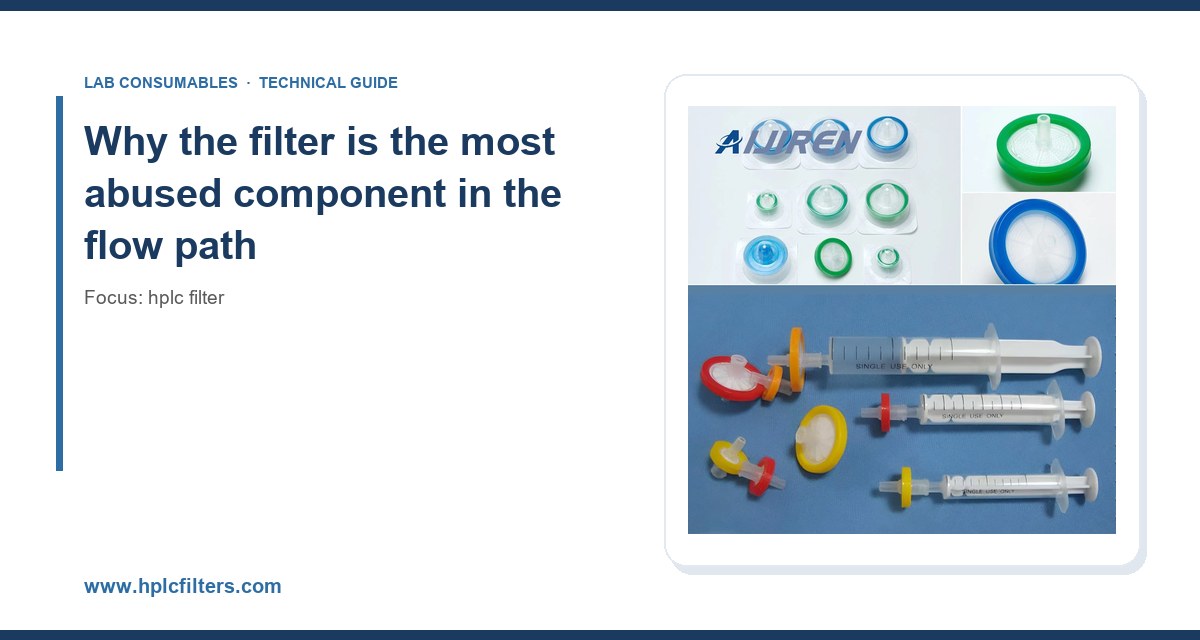
I have watched a filter ruin a Monday morning more times than I can count. The sequence is almost always the same: the baseline drifts, the pump pressure climbs, the injection that ran fine on Friday now shows a split peak, and the analyst blames the column. Nine times out of ten the column is innocent. The filter upstream of it, or the one guarding the mobile phase reservoir, has failed quietly. Over fifteen years running a consumables operation, I have pulled enough clogged frits, burst membranes, and shedding filter discs out of HPLC systems to know that filter failures are rarely random. They cluster around a handful of root causes, and every one of them is preventable with the right hardware and a few habits.
This article covers the failures I see most often in daily use, why they happen at the component level, and what to change so they stop happening. I will give you numbers, dimensions, and torque values, not vague advice.
The HPLC filter sits at the worst possible place in the system: the inlet, where every particle, precipitate, and microbial colony in your mobile phase arrives first. A typical inline filter with a 0.45 µm or 0.2 µm membrane sees the entire solvent stream at full pump pressure. It has a tiny surface area compared with the column, and it has no selectivity. It catches everything that reaches it, which is exactly what you want and exactly why it fails first.
The reference point for particle control is well established. USP <788> sets limits on particulate matter in injections, and the practical rule that has held for decades is to filter mobile phases and samples to 0.45 µm or finer, with 0.2 µm preferred for UHPLC and for columns packed below 2 µm particle size. When a filter does its job, it holds that material. When it fails, that material either passes downstream or the filter blocks flow. Both outcomes cost you a run.
The six failures I see most, and their root causes
1. Premature plugging from unfiltered aqueous buffer
This is the number one cause of short filter life, and it is entirely self-inflicted. Phosphate buffers prepared from salts and stored overnight will grow microbial colonies within 48 hours at room temperature. Those colonies and their debris collect on the filter surface and raise backpressure fast. I have seen a 0.2 µm inline filter on a 10 mM phosphate line go from 15 bar to 90 bar in under a week when the buffer was not vacuum-filtered before use.
The fix is procedural, not hardware. Vacuum-filter every aqueous buffer through a 0.2 µm membrane immediately after preparation, store at 4 °C, and discard after 48 to 72 hours. Add 0.1% sodium azide only if your method allows it, and never with detectors or columns that cannot tolerate azide. A properly prepared buffer will let a good inline filter last weeks instead of days.
2. Membrane rupture from overpressure and incompatible solvents
Not every membrane is built for every solvent. A PTFE membrane handles aggressive organic solvents and strong acids with no problem, which is why it is the default for sample preparation and solvent lines carrying acetonitrile or methanol. A cellulose acetate or nylon membrane in the same line will swell, weaken, and eventually burst. When a membrane ruptures, everything it had been holding goes straight into the column.
Overpressure is the other rupture path. An inline filter rated for a given differential pressure will fail if the pump drives it past that limit, especially after partial plugging has already reduced its effective area. The failure mode is a pinhole or a tear at the seal edge, and it usually happens when nobody is watching. Choose a membrane matched to the solvent, size the filter for the flow rate, and replace it on a schedule rather than waiting for the pressure to spike.
For solvent compatibility and a membrane that holds up under aggressive mobile phases, I standardize on a PTFE membrane filter for anything carrying high-organic or acidic streams. The chemistry is inert, the pore structure is uniform, and it does not shed fibers the way some glass fiber pre-filters do.
3. Extractables and fiber shedding contaminating the baseline
A filter that passes particles can still ruin your chromatography by leaching extractables. Low-grade filter housings, adhesives, and support meshes release oligomers and plasticizers that show up as baseline drift, ghost peaks, and rising noise at low wavelengths. I have traced a persistent 210 nm baseline ramp to a batch of cheap inline filters whose housing plastic was not fluoropolymer. Swapping to a properly specified filter dropped baseline noise from 0.8 mAU to 0.15 mAU overnight.
Fiber shedding is the sibling problem. Glass fiber pre-filters and poorly bonded membrane stacks can release fibers downstream, which then lodge in the column frit. If you use a pre-filter ahead of a membrane, make sure it is bonded or backed so fibers cannot migrate. For critical trace analysis, use a filter with a fluoropolymer housing and a supported membrane, and condition it by flushing 5 to 10 mL of mobile phase before connecting to the column.
4. Wrong pore size for the application
Pore size is a trade-off between protection and backpressure, and getting it wrong causes failures in both directions. A 0.45 µm filter protects a conventional 5 µm column adequately and keeps backpressure low. Put that same filter ahead of a 1.8 µm UHPLC column and particles between 0.2 and 0.45 µm sail through to plug the column frit. Go too fine, on the other hand, and a 0.1 µm filter on a high-flow method will block in days.
Match the filter to the column. For columns packed with particles 3 µm and larger, 0.45 µm is fine. For sub-2 µm UHPLC packings, use 0.2 µm everywhere, including sample prep. For guard applications on capillary or nano systems, go to 0.1 µm and accept the shorter life as the cost of protection.
5. Mechanical damage during installation and handling
A surprising number of failures happen at the bench, not in the flow path. Overtightening a filter housing cracks the seal or deforms the membrane. Undertightening leaves a leak path that bypasses the membrane entirely, so unfiltered liquid reaches the column and the analyst never knows why. Cross-threading a threaded inlet fitting scores the seat and creates a slow leak that shows up as a pressure drop, not a rise. Dropping a filter disc on the bench and picking it up with gloved fingers transfers lint and skin oils that become extractables.
Handle filter discs with flat-tipped forceps, never fingers. Seat threaded fittings hand-tight plus a quarter turn, and follow the manufacturer’s torque spec where one exists (many polymer housings specify 0.5 to 1.0 N·m). If a fitting feels cross-threaded, stop and start over. A stripped fitting is a permanent leak.
6. Microbial growth and biofilm in stored lines
An idle HPLC system is a bioreactor. Aqueous lines left standing over a weekend grow biofilm that sloughs off in sheets when flow resumes, and those sheets land on the filter. The symptom is a burst of backpressure and a cluster of ghost peaks on the first run Monday morning. I have seen a 0.2 µm filter plug solid within two hours of restart after a system sat with phosphate buffer in the lines for four days.
The prevention is a flush routine. Before any idle period longer than 24 hours, flush aqueous lines with 10% to 20% organic (methanol or acetonitrile) and cap the lines. On restart, flush to waste for 15 to 20 minutes before reconnecting the column. If you store buffers, use amber glass and refrigerate. Never leave a phosphate buffer in the system over a weekend.
A comparison table for filter selection
Here is the decision matrix I hand to new lab staff. The numbers are the ones that matter in practice.
- Application: conventional HPLC, 5 µm column. Pore size 0.45 µm. Membrane PTFE or nylon. Typical backpressure budget 5 to 15 bar. Replace every 2 to 4 weeks or at 2× baseline pressure.
- Application: UHPLC, sub-2 µm column. Pore size 0.2 µm. Membrane PTFE. Backpressure budget 10 to 25 bar. Replace every 1 to 2 weeks or at 1.5× baseline pressure.
- Application: high-organic or acidic mobile phase. Pore size 0.2 or 0.45 µm. Membrane PTFE only. Housing fluoropolymer. Condition with 5 to 10 mL flush before use.
- Application: aqueous buffer, microbial risk. Pore size 0.2 µm. Membrane PTFE or PES. Replace weekly. Vacuum-filter buffer first.
- Application: trace analysis, low UV. Pore size 0.2 µm. Membrane PTFE, supported, low-extractable housing. Condition and verify baseline noise below 0.2 mAU before committing samples.
If you are sourcing inline and solvent filters for a mixed lab, start from a catalog that lists membrane chemistry, pore size, housing material, and pressure rating explicitly. The HPLC filter range at hplcfilters.com is organized that way, which saves the guessing that leads to the wrong membrane in the wrong line.
Operational precautions that actually extend filter life
Pressure monitoring and the replacement trigger
Do not wait for a failure to replace a filter. Set a replacement trigger based on pressure. Record the baseline backpressure with a fresh filter and clean mobile phase, then replace when pressure reaches 1.5× to 2× baseline, depending on how much headroom the column has. A filter changed at 1.5× baseline almost never ruptures; one left until it doubles usually does. Log the pressure at the start of every session. The trend line tells you more than any single reading.
Degassing and dissolved gas
Dissolved gas comes out of solution as bubbles when pressure drops across a filter, and those bubbles cause baseline noise and pump cavitation. Degas mobile phases with helium sparging or inline vacuum degassing, and keep the reservoir below 40 °C. A filter that looks fine can still cause noise if the mobile phase is gas-saturated.
Sample preparation hygiene
Most sample-side filter failures start with the sample, not the filter. Centrifuge turbid samples at 10,000 × g for 5 minutes before filtering, and use a syringe filter sized for the volume. A 13 mm syringe filter holds roughly 1 to 10 mL comfortably; pushing 50 mL through one will burst it. For small-volume work where every microliter counts, a vial insert lets you filter and recover a small volume without the dead volume losses that force you to over-push the filter.
Environmental control
Filters stored in humid or dusty environments absorb moisture and particulates before they ever see a sample. Keep filters in their original packaging, sealed, at 15 to 25 °C, away from solvent vapors. A filter left open on the bench for a week is a contamination source, not a safeguard.
Troubleshooting checklist
When a filter problem is suspected, work through this list in order. Each step isolates one variable.
- Check pressure trend. Rising steadily means plugging. Sudden drop means rupture or a bypass leak. Flat but noisy means gas or extractables.
- Swap the filter only. If pressure and baseline recover, the filter was the cause. If not, look downstream at the column frit.
- Inspect the removed filter. Discoloration on the inlet face means sample or buffer debris. A tear at the seal edge means overpressure or overtorque. A swollen membrane means solvent incompatibility.
- Run a blank with fresh mobile phase. Persistent ghost peaks point to extractables or biofilm, not particles.
- Verify pore size against column particle size. Sub-2 µm column with a 0.45 µm filter is a mismatch; fix it.
- Check degassing. Bubble noise that tracks with flow rate is dissolved gas, not a filter fault.
- Confirm fitting torque and thread condition. A leak at the inlet fitting bypasses the membrane entirely.
What the standards and method bodies expect
Method validation under U.S. EPA SW-846 and USP general chapters assumes that sample and mobile phase preparation includes filtration to a defined pore size. If your filter fails mid-sequence, the run is invalid and the data is suspect. That is a compliance issue, not just an inconvenience. Document your filter lot, pore size, and replacement schedule in the method SOP so an auditor can see the control.
For method development and troubleshooting references, the technical libraries from Agilent, Thermo Fisher, and Restek cover frit and filter selection with real pressure and compatibility data. Use them when you are choosing between membrane chemistries rather than guessing.
Recommendation: build a filter program, not a filter habit
Stop treating the filter as a disposable afterthought. Treat it as a controlled component with a specification, a replacement trigger, and a log. My concrete recommendation for a typical QC or method-development lab:
- Standardize on 0.2 µm PTFE for all mobile phase and sample lines feeding sub-2 µm columns, and 0.45 µm for 5 µm columns. Keep both in stock.
- Set the replacement trigger at 1.5× baseline backpressure and log pressure at the start of every session.
- Vacuum-filter every aqueous buffer at 0.2 µm, refrigerate, and discard after 72 hours.
- Flush aqueous lines with 10% to 20% organic before any idle period over 24 hours.
- Hand-tight plus a quarter turn on threaded fittings, or 0.5 to 1.0 N·m where specified. Never force a cross-threaded fitting.
- Condition new filters with 5 to 10 mL of mobile phase and verify baseline noise below 0.2 mAU before committing samples.
- Store filters sealed at 15 to 25 °C, away from solvent vapors, and handle discs with flat-tipped forceps.
For labs running COD or other wet-chemistry checks alongside HPLC, the same filtration discipline applies to sample vials; a COD vial with a clean, matched septum and cap keeps particulates out of the digestion and the analysis. The principle is identical across the bench: control the particles and the microbes before they reach the instrument, and the instrument stops surprising you.
The takeaway is blunt. Almost every filter failure I have investigated in fifteen years came down to one of four things: unfiltered buffer, the wrong membrane chemistry, the wrong pore size for the column, or a filter left in service past its pressure trigger. None of those are hardware mysteries. They are process gaps. Close them with a written filter SOP, a pressure log, and a stock of correctly specified PTFE and matched-pore filters, and the Monday-morning baseline drift stops being a recurring event.
References & further reading
Related resources from our lab consumables network:
- Hplc Filter at hplcfilters.com
- Ptfe Membrane Filter at ptfemembranefilter.com
- Cod Vial at codvial.com
- Vial Insert at hplcinsert.com
External references and standards: