
I have watched a filter take down a validated HPLC sequence more times than I can count. Not because the filter was defective, but because someone in the lab used the wrong pore size, over-torqued the housing, or pulled a filter out of a drawer that had been sitting open since the last audit. After fifteen years running a consumables operation and fielding calls from analytical chemists at 7 a.m., I can tell you that most filter failures are predictable. They follow patterns. And once you know the patterns, you can design them out of your workflow.
This article covers what actually goes wrong with HPLC filters in daily use, why it happens at the component level, and what to change in your SOPs to prevent it. I will give you numbers, not generalities: pore sizes, pressure ratings, torque values, puncture counts, and the specific failure modes I have seen in the field.
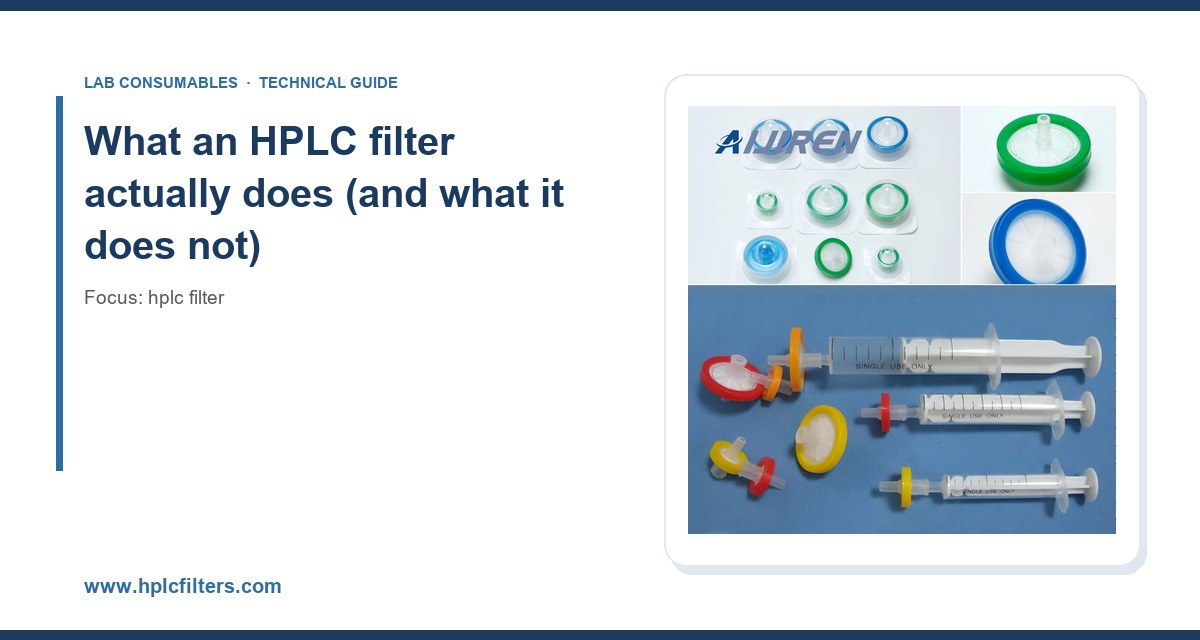
An HPLC filter is a barrier with a defined pore size, typically 0.22 µm or 0.45 µm, held in a housing that connects to your sample path. Its job is to remove particulate matter before it reaches the column, the injector, or the detector flow cell. That is it. It is not a mixing device, it is not a degasser, and it is not a substitute for proper sample preparation.
I have seen labs treat the inline filter as a catch-all for bad sample prep. That is a mistake. A filter that sees heavy particulate load will blind quickly, spike system pressure, and eventually fail. The filter is the last line of defense, not the first. If your samples are coming out of a centrifuge with visible pellet carryover, fix the centrifugation step before you blame the filter.
The two main configurations you will encounter are the syringe-tip filter (used for sample prep before injection) and the inline solvent filter or column guard filter (installed in the flow path). Each has its own failure profile. I will cover both.
Failure mode 1: pore size mismatch and particle breakthrough
Why 0.45 µm is not always the right choice
Many labs default to 0.45 µm filters because they are faster and less prone to clogging. That is fine for general sample cleanup, but it is not fine for everything. If your column has a 2.1 mm internal diameter packed with 1.8 µm particles, a 0.45 µm filter lets through particles that can bridge the column frit. I have seen this cause pressure spikes of 200 to 400 psi within a single sequence on UHPLC systems.
For columns with particle sizes below 3 µm, use 0.22 µm filters. For sub-2 µm columns, consider 0.2 µm or smaller. The pressure penalty is real (roughly 1.5 to 2x higher backpressure through the filter), but it is cheaper than replacing a column.
Particle shedding from the filter itself
This one catches people off guard. Some low-cost membrane filters shed fibers or particles into the filtrate. I have seen PTFE membrane filters with poor backing support release fragments that showed up as ghost peaks in the chromatogram at 210 nm. The fix is to use a filter with a supported membrane and to discard the first 1 to 2 mL of filtrate. If you are running trace analysis, pre-rinse the filter with your mobile phase before use.
For PTFE-specific selection guidance, the Ptfe Membrane Filter resource covers chemical compatibility and housing options that matter for aggressive solvents.
Failure mode 2: chemical incompatibility and membrane degradation
Matching membrane material to mobile phase
This is the failure I see most often in method transfer. A method developed on one system with a nylon filter gets transferred to another lab that stocks cellulose acetate. The filter dissolves, the column sees dissolved polymer, and the run is dead.
Here is the compatibility matrix I use in practice:
- PTFE: compatible with nearly all organic solvents, strong acids, and bases. Use for DMSO, THF, dichloromethane, and concentrated trifluoroacetic acid. Not ideal for aqueous-only mobile phases because it is hydrophobic and requires pre-wetting with alcohol.
- Nylon: good for aqueous and mild organic, but degrades in strong acids and in DMF. I have seen nylon filters swell and rupture in 0.1% TFA in acetonitrile after extended contact.
- PVDF: good general-purpose choice for aqueous and organic. Low protein binding. Not for strong bases above pH 12.
- Cellulose acetate: fine for aqueous, poor for organic solvents. Avoid with acetonitrile.
- PES (polyethersulfone): high flow rate, low extractables, good for aqueous buffers. Not for chlorinated solvents.
If you are running EPA SW-846 methods with mixed organic extracts, check the method’s specified filter material before substituting. The U.S. EPA SW-846 test methods documentation lists acceptable filter types for each extraction procedure.
Extractables and ghost peaks
Every membrane has extractables. The question is whether they show up in your chromatogram. I have measured extractable levels from 10 to over 200 ppm depending on membrane type and manufacturer. For trace analysis at ppb levels, even low-extractable membranes need a rinse step. Run 5 to 10 mL of mobile phase through a syringe filter before you collect the filtrate. It takes 30 seconds and saves you a re-run.
Failure mode 3: over-torquing and housing damage
The torque problem
Inline filter housings are typically made of PEEK or stainless steel. The fittings are usually 1/16 inch or 1/8 inch and use ferrule connections. The most common field failure I see is a cracked PEEK housing from over-tightening. PEEK has a glass transition temperature around 143°C and a tensile strength that drops sharply with repeated stress. A cracked housing leaks, and a leak at 400 bar is a safety issue.
My rule: hand-tight plus 1/4 turn for PEEK fittings. For stainless steel, use a torque wrench set to 0.5 to 0.7 N·m (4 to 6 in·lb). Do not guess. I have seen labs where every fitting was tightened “until it felt right,” and half of them were cracked.
Cross-threading and stripped ports
Cross-threading happens when someone forces a fitting into a port at an angle. The threads strip, the connection leaks, and the port is ruined. Replacement ports are not cheap. The fix is simple: thread by hand until the fitting seats, then apply torque. If it does not thread smoothly, stop. Do not force it.
Failure mode 4: pressure spikes and flow restriction
Blinding from particulate load
A filter blinds when the particulate load exceeds its capacity. The symptom is a steady pressure rise over the course of a sequence, often 50 to 100 psi per injection. By the time the operator notices, the run is compromised. I recommend tracking system pressure per injection and setting a 10% pressure increase threshold as a trigger for filter replacement.
If you are running high-particulate samples (environmental extracts, biological matrices, formulated products), use a pre-filter or a larger-diameter filter to increase capacity. A 25 mm diameter filter has roughly 4x the capacity of a 13 mm filter. The trade-off is dead volume and sample loss, but for dirty samples, it is worth it.
Air locks and priming failures
An inline filter that is not properly primed will trap air. The symptom is erratic pressure and noisy baseline. The fix is to prime the filter with mobile phase before installing it, and to bleed the system after installation. I have seen operators skip this step because “the pump will push the air out.” It will, eventually, but not before you waste a sequence.
Failure mode 5: contamination and carryover
Microbial growth in aqueous mobile phases
Aqueous buffers sitting in a filter housing for more than 48 to 72 hours will grow microbes. I have seen this in phosphate buffers at pH 7, where biofilm formed on the filter surface and shed into the flow path. The result was a baseline drift and ghost peaks that took a week to diagnose. The fix: prepare fresh buffer, filter it through a 0.22 µm filter into a clean bottle, and do not store it in the system overnight without flushing.
Carryover from previous samples
A filter that is reused (yes, some labs reuse syringe filters) will carry over compounds from the previous sample. I have seen carryover of 0.5 to 2% from a high-concentration sample into a low-concentration one. Syringe filters are single-use. Do not reuse them. The cost of a filter is trivial compared to the cost of a failed run.
For sample handling consumables that pair with your filter workflow, including Vial Insert options for low-volume samples, the compatibility of the insert with your autosampler matters as much as the filter itself.
Failure mode 6: mechanical failure at the seal
O-ring degradation
Most inline filter housings use an O-ring or gasket to seal the connection. These are typically Viton or PTFE. Viton is compatible with most solvents but swells in ketones and amines. PTFE is more inert but has lower elasticity and can cold-flow under pressure. I have seen Viton O-rings swell by 10 to 15% after contact with MEK, causing a leak that only appeared at high pressure.
Check your O-ring material against your solvent list. If you are running ketones, switch to PTFE or Kalrez. The cost difference is small compared to the downtime.
Frit collapse
The frit (the porous disc that supports the membrane) can collapse under high pressure. This happens when the filter is installed backwards or when the pressure exceeds the frit’s rating. Most frits are rated to 100 to 200 bar. If your system runs at 400 bar, you need a high-pressure filter housing. I have seen frits crack and send membrane fragments downstream, which is a column-killer.
Failure mode 7: incorrect installation and orientation
Many inline filters are directional. The flow must go from the inlet to the outlet in the specified direction. Installing backwards reverses the support structure and causes the membrane to fail under pressure. I have seen this happen more than once, usually during a late-night shift change. The fix is to mark the flow direction on the housing with a permanent marker and to include orientation in your installation SOP.
For general guidance on filter selection and installation, the Hplc Filter resource covers housing types, pore sizes, and compatibility charts.
Failure mode 8: storage and shelf-life issues
Improper storage
Filters stored in a humid environment or exposed to solvent vapors will degrade. I have seen filters that were stored in an open box on a bench for six months develop mold on the membrane. The fix is to store filters in a sealed container with desiccant, away from solvent vapors. Check the expiry date. Most manufacturers specify a 2 to 3 year shelf life for unused filters.
Lot-to-lot variability
Not all filters are manufactured to the same tolerance. I have seen lot-to-lot variability in pore size of ±0.05 µm, which is enough to change the filtration performance. If you are running a validated method, stick with a single manufacturer and lot number where possible. For critical applications, request a certificate of analysis with pore size and extractables data.
Troubleshooting checklist
Here is the checklist I use when a filter-related problem appears. Work through it in order. Most issues resolve within the first four steps.
- Check system pressure trend. A steady rise of more than 10% over a sequence indicates blinding. Replace the filter.
- Check for leaks at the housing. A leak at 400 bar is a safety issue. Depressurize, inspect the O-ring and fitting, and re-torque to 0.5 to 0.7 N·m.
- Check the membrane material against the mobile phase. Use the compatibility matrix above. If in doubt, switch to PTFE.
- Check the pore size against the column particle size. Use 0.22 µm for columns with particles below 3 µm.
- Check for ghost peaks. If present, pre-rinse the filter with 5 to 10 mL of mobile phase and re-run.
- Check the installation orientation. Confirm flow direction matches the housing arrow.
- Check the filter age and storage conditions. Replace if older than the manufacturer’s shelf life or stored improperly.
- Check for microbial growth in aqueous systems. Flush the system with 10% isopropanol and replace the filter if biofilm is suspected.
Comparison: filter selection by application
Here is a decision table I use when specifying filters for different applications. The numbers are based on typical lab conditions and should be verified against your specific method.
- UHPLC, sub-2 µm column, aqueous/organic mobile phase: PTFE or PES, 0.2 µm, 13 mm diameter, pressure rating ≥ 400 bar. Pre-rinse with 5 mL mobile phase.
- HPLC, 3 to 5 µm column, reverse-phase: PVDF or PTFE, 0.22 µm, 13 or 25 mm diameter, pressure rating ≥ 200 bar. Single use.
- Environmental extracts (SW-846): PTFE, 0.45 µm, 25 mm diameter, compatible with dichloromethane and acetone. Check method-specific requirements.
- Biological samples (protein-containing): PES or PVDF, 0.22 µm, low protein binding, 13 mm diameter. Pre-rinse with buffer.
- High-particulate samples: Glass fiber pre-filter followed by PTFE 0.45 µm, 25 mm diameter. Replace pre-filter every 10 to 20 samples.
For instrument-specific recommendations, the Agilent chromatography consumables and columns catalog and the Thermo Fisher chromatography and sample handling resources list compatible filter part numbers for common systems. The Restek technical resources for chromatography site has useful guidance on filter selection for GC and HPLC methods.
Prevention: what to change in your SOPs
Standardize on one filter type per method
Do not let individual analysts choose their own filters. Standardize on one membrane material, one pore size, and one manufacturer per method. Document it in the SOP. This eliminates the lot-to-lot and material variability that causes most ghost peak and pressure issues.
Set a replacement schedule
Do not wait for a filter to fail. Replace inline filters every 100 to 200 injections or every 2 weeks, whichever comes first. For high-particulate samples, replace every 20 to 50 injections. Track replacement dates in your maintenance log.
Train on torque and orientation
Include torque values and flow direction in your training. Provide a torque wrench. Mark the flow direction on the housing. I have seen labs cut filter failures by 60% just by adding these two items to their training.
Use pre-filters for dirty samples
A glass fiber pre-filter costs a fraction of a column and extends filter life by 3 to 5x for high-particulate samples. Use it.
Store filters properly
Keep filters in a sealed container with desiccant. Do not store them on the bench. Check expiry dates monthly.
If you are also managing COD or other colorimetric sample prep, the Cod Vial resource covers vial compatibility and handling that pairs with your filtration workflow.
Takeaway
Most HPLC filter failures are not random. They come from pore size mismatch, material incompatibility, over-torquing, improper storage, and reuse. Each of these has a specific fix: use 0.22 µm for small-particle columns, match membrane material to mobile phase, torque to 0.5 to 0.7 N·m, store sealed with desiccant, and never reuse a syringe filter. Standardize your filter selection, set a replacement schedule, and train on the two things that cause the most field failures: torque and orientation. Do that, and your filter stops being the weak point in your sequence.
References & further reading
Related resources from our lab consumables network:
- Hplc Filter at hplcfilters.com
- Ptfe Membrane Filter at ptfemembranefilter.com
- Cod Vial at codvial.com
- Vial Insert at hplcinsert.com
External references and standards: