
I once watched a QC analyst inject a sample that had been filtered through a 0.45 µm nylon syringe filter into a 100 × 4.6 mm C18 column, and the backpressure jumped from 92 bar to 210 bar inside four injections. The culprit was not the column. It was the filter membrane swelling in a 60% acetonitrile mobile phase and shedding fines downstream. That afternoon cost us a column and half a day of method validation. Filter selection is not a footnote in sample preparation. It is part of the analytical method, and it deserves the same care you give to mobile phase composition or injection volume.
This guide is what I wish I had handed that analyst on day one. It covers membrane chemistry, pore size, housing format, extractables, compatibility, dead volume, and the small mechanical details (torque, puncture counts, vial geometry) that decide whether a run is clean or a troubleshooting session. If you are buying for a lab or writing an SOP, the numbers and checklists below should get you to a defensible choice.
An HPLC filter has one job: remove particulate matter before it reaches the column, the frit, or the detector cell. Particles above roughly one tenth of the column particle size will bridge across the inlet frit and start the pressure climb. On a 3 µm column, that means anything above about 0.3 µm is a risk. On a 1.8 µm sub-2 µm column, even 0.2 µm filtration is marginal, which is why many UHPLC methods specify 0.2 µm and a guard column.
Filtration happens at three points in a typical workflow:
- Sample preparation: syringe filters (13 mm, 25 mm, 33 mm) or centrifugal filter vials used before the autosampler vial is filled.
- Mobile phase preparation: solvent filtration through 47 mm or 50 mm membrane discs under vacuum, usually 0.45 µm for HPLC and 0.2 µm for UHPLC or LC-MS.
- Inline protection: column inlet filters, guard cartridges, and frit assemblies that catch what the sample prep missed.
Each point has different requirements. A syringe filter must be low-extractable and mechanically strong under hand pressure. A solvent filter disc must be solvent-resistant and rated for vacuum. An inline frit must survive system pressure and not contribute dead volume. Buying one product to cover all three is how labs end up with ghost peaks and split peaks.
Membrane chemistry: the decision that causes most failures
Membrane material determines chemical compatibility, extractables, protein binding, and whether the filter will physically survive the sample. Get this wrong and no amount of careful technique will save the run.
PTFE (hydrophobic and hydrophilic)
Hydrophobic PTFE is the default for aggressive organic solvents, strong acids, and bases. It is essentially inert to almost everything an HPLC lab throws at it, and extractables are low. The catch is that hydrophobic PTFE will not wet with aqueous samples. For aqueous or mixed samples, use hydrophilic PTFE (often sold as H-PTFE or PTFE with a hydrophilic surface treatment). If you are buying PTFE for mobile phase or sample filtration across a mixed solvent range, look at the specifications on a PTFE membrane filter datasheet and confirm whether it is hydrophobic or hydrophilic before you commit. I have seen a whole batch of aqueous samples rejected because someone grabbed the hydrophobic box.
Nylon
Nylon is hydrophilic, has good mechanical strength, and works well for aqueous samples and many organic solvent mixes. It binds proteins and some basic analytes, so it is a poor choice for peptide or protein work unless recovery has been validated. Nylon also swells in some solvents (notably certain chlorinated and fluorinated solvents) and can shed fines if the housing is poorly welded. For general pharmaceutical potency assays in aqueous/organic mobile phases, nylon at 0.45 µm is a workhorse.
PVDF (hydrophilic)
PVDF has low protein binding, good solvent resistance, and is a common choice for bioanalytical and LC-MS work. It is compatible with most aqueous and organic mixes and holds up better than nylon in dimethyl sulfoxide and some aggressive solvents. Extractables are low but not zero; for trace-level LC-MS methods, run a filter blank before you trust it.
PES (polyethersulfone)
PES is fast-flowing and low-binding, which makes it popular for aqueous and biological samples. It is not the best choice for high organic content or strong solvents. If your sample is 80% acetonitrile, PES is the wrong membrane.
Cellulose acetate and regenerated cellulose
These are low-binding and good for aqueous samples, but they hydrolyze in strong acids and bases and are not suitable for many organic solvents. I keep them for aqueous buffer samples only.
Glass fiber and quartz
These are depth filters, not membrane filters. They are used as pre-filters upstream of a membrane or for very dirty samples where you need high particulate load capacity. They do not give you a sharp pore-size cutoff, so do not use them as the final filtration step before a column.
Pore size: 0.45 µm, 0.2 µm, or something else
The old rule was 0.45 µm for HPLC and 0.2 µm for UHPLC. That is still a reasonable starting point, but the real rule is based on column particle size and detector sensitivity.
- 5 µm columns: 0.45 µm filtration is usually adequate. Use 0.2 µm if the sample is dirty or the method is prone to frit plugging.
- 3 µm columns: 0.2 µm is safer. The pressure penalty for a partially plugged frit is higher on smaller particles.
- Sub-2 µm (UHPLC) columns: 0.2 µm minimum, and consider a guard column or inline filter. Some labs use 0.1 µm for very dirty matrices, but flow rate drops and you need to check recovery.
- LC-MS and trace analysis: 0.2 µm with a low-extractable membrane. Filter blanks are mandatory.
Pore size is nominal, not absolute. A 0.45 µm membrane will pass some particles larger than 0.45 µm, especially under high differential pressure or with deformable particles. If your method is sensitive to fines, use 0.2 µm even on a 5 µm column.
Housing format and the dead-volume problem
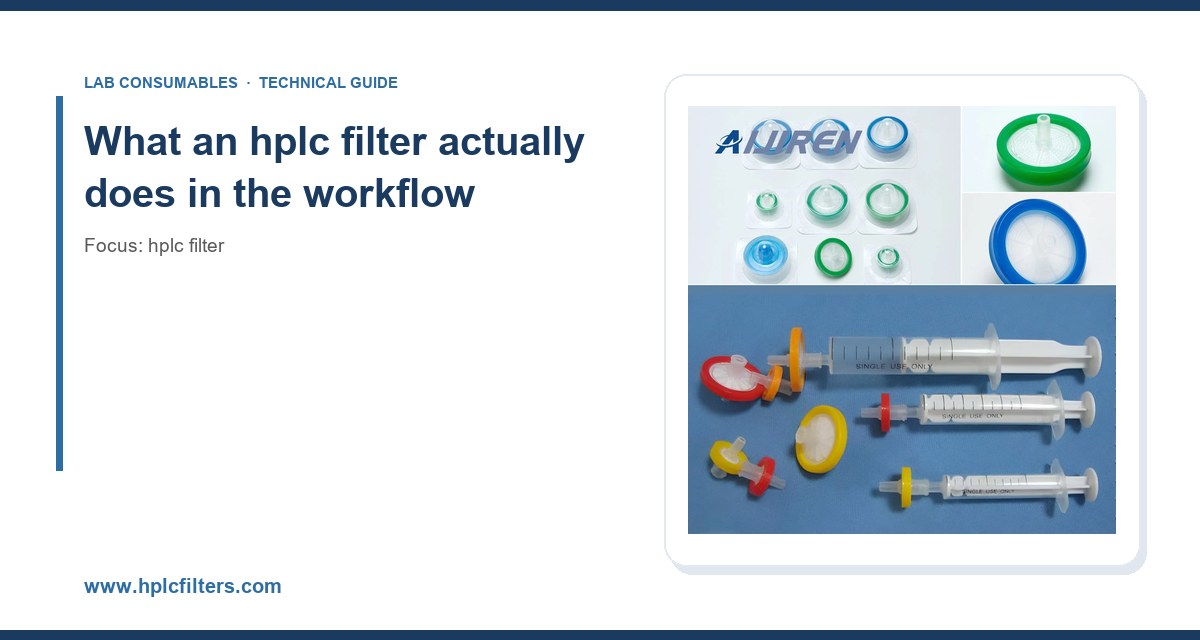
The membrane gets the attention, but the housing decides whether the filter is usable in your workflow. Syringe filters come in 4 mm, 13 mm, 17 mm, 25 mm, 33 mm, and larger diameters. Hold-up volume scales with diameter and housing design. A 13 mm filter might hold 10 to 30 µL; a 25 mm filter can hold 100 µL or more. If you are filtering 200 µL of sample for a low-volume injection, a 25 mm filter can swallow a meaningful fraction of your analyte, especially if the membrane adsorbs.
For small sample volumes, use a 4 mm or 13 mm filter and push slowly. For viscous samples or high particulate loads, a 25 mm or 33 mm filter gives more surface area and less plugging. The trade-off is dead volume and sample loss.
Housing material matters too. Polypropylene is standard and generally compatible. Some housings use acrylic or other polymers that can leach into aggressive solvents. Check the housing material on the datasheet, not just the membrane.
Centrifugal filter vials are a different format: the membrane sits in a insert inside a vial, and you spin the vial in a centrifuge to push sample through. These are convenient for automation and low-volume samples, but you need to match the vial geometry to your autosampler. If you are using a vial insert to reduce sample volume, confirm that the filter vial and insert are compatible with your autosampler needle depth and vial height. I have seen needles bend because a filter vial was 1 mm taller than the standard vial the autosampler was calibrated for.
Extractables and leachables: the ghost peak source
Every filter contributes something to the filtrate. The question is whether that something shows up in your chromatogram. Extractables come from the membrane, the housing, the support layer, and any wetting agents or release agents used in manufacturing.
For trace analysis (ppb levels), LC-MS, or methods with low UV detection limits, run a filter blank: filter a volume of your mobile phase or sample diluent through the filter and inject it under the same method. Look for peaks above the baseline noise. If you see peaks, try a different membrane or pre-rinse the filter with 1 to 2 mL of diluent and discard the first portion.
Some membranes are marketed as low-extractable or “LC-MS compatible.” That is a useful starting point, but it is not a substitute for a blank injection on your method. I have seen a “low-extractable” PVDF filter produce a consistent peak at the analyte retention time in a method with 0.1 µg/mL detection limit. The fix was a different lot, not a different membrane.
For mobile phase filtration, extractables are less of a concern because the solvent volume is large and the filter is upstream of the column, but particulate shedding is still a risk. Use a filter disc that is rated for vacuum and does not shed fibers. Glass fiber pre-filters can shed, so use them upstream of a membrane, not as the final step.
Chemical compatibility: a practical matrix
Compatibility charts are useful, but they are often optimistic. The table below is a conservative starting point based on what I have seen work and fail in real labs.
- Acetonitrile, methanol, isopropanol: PTFE, PVDF, nylon (with caution), PES (short exposure). Avoid cellulose acetate for long exposure.
- Water and aqueous buffers (pH 2 to 8): PES, PVDF, nylon, cellulose acetate, hydrophilic PTFE.
- Strong acids (pH below 2): PTFE, PVDF. Avoid nylon and cellulose acetate.
- Strong bases (pH above 10): PTFE, PVDF. Avoid nylon, cellulose acetate, and PES for prolonged exposure.
- Dichloromethane, chloroform: PTFE. Nylon and PVDF may swell or degrade.
- Dimethyl sulfoxide, dimethylformamide: PTFE, PVDF. Avoid PES and cellulose acetate.
- Tetrahydrofuran: PTFE. Many other membranes swell or dissolve.
If your sample is a mix, test the worst-case solvent. A filter that survives 100% aqueous may fail in 50% acetonitrile. And remember that temperature changes compatibility: a filter rated to 60 °C may fail at 80 °C.
Mechanical details that decide whether the run is clean
The unglamorous parts of filter selection are often the ones that cause the most trouble. Here are the ones I check before signing off on a purchase.
Pressure rating and burst
Syringe filters are rated for hand pressure, typically up to 5 to 7 bar (70 to 100 psi) for 13 mm and 25 mm formats. If you are using a syringe pump or a pressurized sample preparation system, check the burst rating. A filter that bursts in a centrifuge or under nitrogen pressure sends sample into the filtrate and ruins the run.
Hold-up volume and recovery
Ask for the hold-up volume in the datasheet. For small volumes, pre-rinse with diluent and discard the first 0.5 to 1 mL. For analytes that adsorb, use a low-binding membrane and validate recovery at your concentration.
Housing weld and leak points
Cheap filters can leak at the housing seam under pressure. If you see sample on the outside of the filter, stop. A leak is a contamination risk and a recovery problem.
Luer lock and connection
Most syringe filters use a female Luer lock inlet and a male Luer slip or lock outlet. Check that your syringe and any downstream vial adapter match. A Luer slip outlet can pop off under pressure, especially with viscous samples.
Autosampler vial compatibility
If you are using filter vials or inserts, check the dimensions against your autosampler specification. Standard 12 × 32 mm vials, 11 mm crimp or screw caps, and insert heights vary by manufacturer. A 1 mm difference can cause needle crashes or sample pickup errors. If your method uses a COD vial for water analysis, confirm that the filter vial and cap are compatible with the same autosampler tray and needle depth.
Buying checklist with concrete numbers
Use this checklist when comparing suppliers or writing a purchase specification. The numbers are starting points; adjust for your method.
- Membrane: match to solvent (PTFE for aggressive organics, PVDF or PES for aqueous, nylon for general aqueous/organic with recovery validation).
- Pore size: 0.45 µm for 5 µm columns, 0.2 µm for 3 µm and sub-2 µm columns, 0.2 µm for LC-MS.
- Diameter: 4 mm or 13 mm for sample volumes under 1 mL; 25 mm or 33 mm for volumes above 1 mL or high particulate load.
- Hold-up volume: under 30 µL for 13 mm; under 100 µL for 25 mm (verify on datasheet).
- Pressure rating: at least 5 bar (70 psi) for syringe use; higher for pressurized systems.
- Housing: polypropylene, with a welded seam and no visible flash or parting lines.
- Extractables: low-extractable grade for LC-MS and trace analysis; filter blank required.
- Connections: female Luer lock inlet, male Luer lock or slip outlet; check syringe and vial adapter compatibility.
- Sterility: not required for HPLC unless the method demands it; sterile filters cost more and may have different extractables.
- Lot traceability: certificate of analysis with membrane lot and housing lot for regulated work.
For mobile phase discs, add: 47 mm or 50 mm diameter, vacuum rating, and compatibility with your solvent. For inline filters, add: system pressure rating, dead volume, and replacement interval.
Operational precautions that save columns
Even a well-chosen filter can fail if the technique is wrong. These are the habits I enforce in my lab.
- Pre-rinse: pass 1 to 2 mL of diluent through a new filter and discard before filtering sample. This removes loose particles and manufacturing residues.
- Push slowly: high pressure can force particles through the membrane and deform the housing. Use a steady, moderate push.
- Do not reuse: syringe filters are single-use. Reusing a filter risks cross-contamination and membrane damage.
- Filter fresh: filter immediately before injection. A filtered sample that sits for hours can grow particles or adsorb analyte.
- Check the blank: run a filter blank at least once per lot, and whenever you change membrane or supplier.
- Watch the pressure: a rising system pressure after a filter change points to fines or a partially plugged frit. Stop and investigate.
- Store correctly: keep filters in the original packaging, away from solvent vapors and dust. A filter left open on the bench picks up particles.
For mobile phase filtration, degas after filtration. Vacuum filtration can introduce air, and air in the pump can cause baseline noise and retention time drift. Use a 0.45 µm or 0.2 µm disc, and do not filter through a filter that has been sitting wet in the funnel.
Troubleshooting checklist
When a run goes wrong, work through this list before you blame the column.
- Rising backpressure: check for particulate in the sample, filter pore size, and inline frit. Replace the filter and flush the column.
- Ghost peaks: run a filter blank. If peaks appear, change membrane or pre-rinse. Check mobile phase filter and water source.
- Low recovery: check membrane binding (nylon and protein), hold-up volume, and pre-rinse. Try a low-binding membrane.
- Split or tailing peaks: check for void at the column inlet, frit plugging, and sample solvent strength. A filter that sheds fines can cause partial plugging.
- Baseline drift: check mobile phase filtration and degassing. A filter that sheds fibers can cause detector noise.
- Leaks at the filter: check Luer connection and housing weld. Replace the filter and check pressure rating.
- Needle crashes: check vial and insert height against autosampler specification. A filter vial that is 1 mm too tall can bend a needle.
- Inconsistent results between analysts: check filter lot, pre-rinse technique, and push pressure. Standardize the SOP.
Where to buy and what to ask
For a full range of syringe filters, membrane discs, and inline filters, start with the HPLC filter catalog and compare membrane, pore size, and housing specifications side by side. For method development and instrument-specific consumables, the technical resources from Agilent and Thermo Fisher are useful for cross-checking column and filter compatibility. For regulated environmental work, the U.S. EPA SW-846 test methods specify sample preparation and filtration requirements that your filter choice must meet. Restek publishes compatibility and troubleshooting guides that are worth keeping on the bench.
When you request a quote, ask for: membrane material and pore size, housing material, hold-up volume, pressure rating, extractables data or a blank chromatogram, lot traceability, and the certificate of analysis. A supplier who cannot provide these is not a supplier for regulated work.
Recommendation
For a general HPLC lab running 5 µm columns with aqueous/organic mobile phases, I would standardize on 0.45 µm PVDF or nylon 13 mm syringe filters for sample prep, 0.2 µm PVDF or hydrophilic PTFE for UHPLC and LC-MS, and 0.45 µm PTFE or nylon 47 mm discs for mobile phase. For aggressive solvents, use hydrophobic PTFE. For trace analysis, use a low-extractable membrane and run a filter blank on every lot. For small volumes, use a 4 mm or 13 mm filter with a hold-up volume under 30 µL. For automation, use filter vials and inserts that match your autosampler geometry, and check the height against the vial specification before you buy a case.
The filter is the cheapest part of the run and the easiest to get wrong. Match the membrane to the solvent, the pore size to the column, the format to the sample volume, and the housing to the pressure. Then run a blank. That sequence has saved me more columns than any instrument upgrade.
References & further reading
Related resources from our lab consumables network:
- Hplc Filter at hplcfilters.com
- Ptfe Membrane Filter at ptfemembranefilter.com
- Cod Vial at codvial.com
- Vial Insert at hplcinsert.com
External references and standards: