
I once watched a lab burn through a full box of 0.45 µm syringe filters in three days because nobody checked the sample matrix first. The filters clogged at 0.2 mL, the analyst pushed harder, the membrane ruptured, and a batch of 40 samples had to be re-prepped. The filters were fine. The selection was wrong. That experience shaped how I think about buying HPLC filters: the spec sheet matters less than the match between membrane chemistry, pore size, hold-up volume, and the sample you actually have in front of you.
This guide covers the selection criteria I use when specifying filters for a chromatography lab, the failure modes that cost the most time, and the numbers that should drive your purchase order. It is written for procurement managers who need to justify a line item and for analysts who have to make the thing work at 4 p.m. on a Friday.
An HPLC filter is a physical barrier that removes particulates before they reach the column, the injector, or the detector. That is the whole job. The complications come from where the filter sits and what it is made of.
There are four common positions in a workflow:
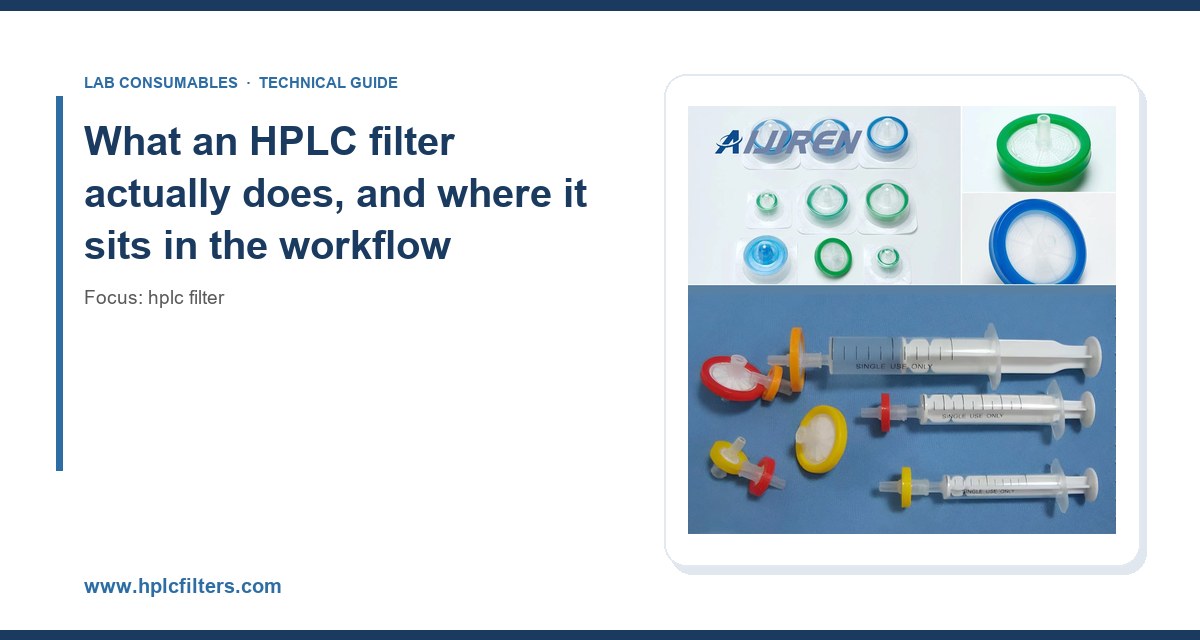
- Syringe filters (13 mm, 25 mm, 33 mm diameter) for clarifying prepared samples before vial filling. Pore sizes are typically 0.45 µm for general work and 0.22 µm for UHPLC or when particulate load is high.
- Inline solvent filters (also called mobile phase filters or reservoir filters) that sit on the end of the solvent inlet line, usually 10 µm stainless frit or 0.2 µm PTFE, to keep reservoir particulates out of the pump.
- Column inlet frits that are part of the column hardware and protect the packed bed. These are not user-selectable in most cases, but they define the particle size you must filter to upstream.
- Filter vials and integrated filter caps that combine filtration and sample containment in one step, common in high-throughput labs running 96-well autosamplers.
The rule of thumb that has held up across every lab I have run: filter to at least one-third the size of the column inlet frit. A column with a 2 µm inlet frit wants samples filtered to 0.45 µm or finer. A UHPLC column with sub-2 µm particles and a 0.5 µm frit wants 0.22 µm filtration, and honestly, I would not run unfiltered sample on a sub-2 µm column at all.
Membrane chemistry: the decision that matters most
Pore size gets all the attention. Membrane chemistry causes most of the problems. I have seen more assays ruined by the wrong polymer than by the wrong pore size.
PTFE (polytetrafluoroethylene)
Hydrophobic PTFE is the default for organic solvents, aggressive mobile phases, and anything containing strong acids or bases. It is chemically inert to almost everything a chromatography lab throws at it. The catch is that hydrophobic PTFE will not wet with aqueous solutions, so you need a hydrophilic PTFE variant (often called H-PTFE) for water-based samples. A PTFE membrane filter is what I reach for when the sample contains DMSO, THF, or dichloromethane, because cellulose acetate and nylon will not survive those solvents.
Typical specifications for a 13 mm hydrophobic PTFE syringe filter: 0.22 µm or 0.45 µm pore, hold-up volume around 10 to 25 µL, burst pressure above 100 psi, and a recommended operating temperature up to 130 °C for short exposures. Housing material matters too: polypropylene housings are standard, but if you are running trace analysis for plasticizers, ask for PTFE or PFA housings.
Nylon
Nylon is hydrophilic, has excellent protein binding characteristics (which is sometimes good, sometimes terrible), and works well with aqueous and mild organic mobile phases. It is a poor choice for samples containing strong acids or high concentrations of DMF. Nylon also adsorbs some analytes, so if you are running trace-level work at low ng/mL concentrations, run a recovery check before committing to a method.
PVDF (polyvinylidene fluoride)
PVDF is hydrophilic, low protein binding, and compatible with a broader solvent range than nylon. It is my default for aqueous biological samples and for methods where recovery of hydrophobic analytes matters. It is not compatible with strong bases or DMSO at high concentrations.
Cellulose acetate and cellulose nitrate
Cheap, widely available, and fine for general aqueous filtration. Not compatible with many organic solvents (acetone, DMSO, and DMF will dissolve or swell the membrane). I use cellulose acetate for buffer preparation and general particulate removal, not for sample prep in methods that involve significant organic content.
PES (polyethersulfone)
PES has low protein binding and high flow rates, which makes it popular for biological samples and for large-volume filtration. It is compatible with a moderate range of solvents but not with ketones or chlorinated solvents at high concentration.
A comparison table for the four main chemistries
Here is the decision matrix I keep on the wall. Numbers are typical values for 13 mm syringe filters; check the specific manufacturer’s certificate of analysis before you commit.
- PTFE (hydrophobic): Aqueous compatibility: no. Organic solvent compatibility: excellent. Hold-up volume: 10 to 25 µL. Typical burst pressure: >100 psi. Best for: DMSO, THF, DCM, strong acids and bases.
- PTFE (hydrophilic): Aqueous compatibility: yes. Organic solvent compatibility: excellent. Hold-up volume: 15 to 30 µL. Burst pressure: >80 psi. Best for: mixed aqueous/organic mobile phases, general sample prep.
- Nylon: Aqueous compatibility: yes. Organic solvent compatibility: good (not DMF, not strong acids). Hold-up volume: 10 to 20 µL. Protein binding: high. Best for: aqueous samples where protein removal is desired.
- PVDF: Aqueous compatibility: yes. Organic solvent compatibility: good (not DMSO, not strong bases). Hold-up volume: 10 to 20 µL. Protein binding: low. Best for: biological samples, trace recovery work.
- PES: Aqueous compatibility: yes. Organic solvent compatibility: moderate. Hold-up volume: 15 to 30 µL. Flow rate: high. Best for: large-volume aqueous filtration.
- Cellulose acetate: Aqueous compatibility: yes. Organic solvent compatibility: poor. Hold-up volume: 20 to 40 µL. Best for: buffer prep and general particulate removal.
Pore size: 0.45 µm versus 0.22 µm and when to go smaller
For decades the default was 0.45 µm. That is still correct for conventional HPLC columns packed with 5 µm particles and inlet frits of 2 µm. It is not correct for UHPLC.
If you are running a column with sub-2 µm particles, the inlet frit is typically 0.5 µm or smaller. Filtering to 0.45 µm leaves particles that can bridge the frit and spike backpressure. I specify 0.22 µm for every UHPLC method and for any method where the sample has visible turbidity or high dissolved solids.
For methods that require removal of very fine particulates (environmental extracts, biological matrices, and anything headed for a mass spectrometer), 0.1 µm filters are available and worth the extra cost. Expect lower flow rates and higher hold-up volume, so plan for a larger filter diameter (25 mm instead of 13 mm) to keep the sample moving.
One number to keep in mind: a 13 mm filter with a 0.22 µm pore has roughly 0.5 cm² of effective filtration area. That is small. If you have more than about 1 mL of sample with any appreciable particulate load, use 25 mm. I have seen 13 mm filters clog at 0.3 mL on environmental water samples because the analyst underestimated the suspended solids.
Hold-up volume, dead volume, and the recovery problem
Every filter retains some sample. That retained volume is the hold-up volume, and it matters when you are working with small sample volumes or trace analytes.
A 13 mm syringe filter typically holds 10 to 25 µL in the membrane and housing. A 25 mm filter holds 40 to 80 µL. A 33 mm filter can hold 100 to 150 µL. If you have 500 µL of sample and you push it through a 33 mm filter, you might recover 350 µL. That is fine for a general assay. It is not fine if you need every microliter for a low-concentration standard curve.
Two operational rules I enforce:
- Discard the first 3 to 5 drops (roughly 100 to 150 µL) of filtrate. That volume is where extractables from the housing and membrane concentrate.
- Pre-rinse the filter with a small volume of the same solvent or mobile phase before pushing the sample through. This is standard practice for trace analysis and cuts background peaks significantly.
If sample volume is tight, consider a vial insert in the autosampler vial. A 150 µL insert lets you run a 100 µL sample without wasting it on the bottom of a 2 mL vial. The combination of a small-diameter filter and an insert is how you get a full injection out of a 200 µL sample.
The housing, the connections, and the numbers that matter
Membrane chemistry gets the specification sheet. Housing and connections cause the leaks.
Luer fittings and torque
Standard syringe filters use a female Luer-Lok inlet and a male Luer-slip or Luer-Lok outlet. The connection is friction-based, and over-tightening will crack the housing. I tell new analysts to hand-tighten to the point of contact and then no more than a quarter turn. If you need a torque number for a threaded fitting elsewhere in the system, the standard for stainless HPLC fittings is about 0.5 to 0.8 N·m (roughly 4 to 7 in-lb) for a 1/16 inch fitting with a ferrule. Over-torquing deforms the ferrule and creates a leak path that no amount of tightening will fix.
Pressure ratings
Syringe filters are rated for a burst pressure. Typical values are 80 to 130 psi for a 13 mm unit and 60 to 100 psi for a 25 mm unit. That is well above what a hand syringe generates, but not above what a syringe pump or a vacuum manifold can generate. If you are using a positive-pressure manifold, check the rating. I have seen 25 mm filters blow the membrane at 90 psi because the analyst assumed the housing was the weak point. It is not.
Autoclavability and temperature
Most polypropylene-housed syringe filters are autoclavable at 121 °C for 15 to 20 minutes. PTFE membranes tolerate higher temperatures (up to 130 °C for short cycles), but the housing is usually the limiting factor. If your workflow requires sterile filtration, buy pre-sterilized filters rather than autoclaving in-house. The re-sterilization step introduces a contamination risk that is hard to justify.
Extractables
Every filter sheds something. The question is whether the shed material interferes with your detection. For UV detection at 210 to 220 nm, housing extractables show up as baseline drift and ghost peaks. For LC-MS work, polymer extractables can show up as background ions in the m/z 200 to 600 range. If you are running trace analysis, buy filters with a certificate of analysis that specifies extractables, and run a blank filtration before you commit a method.
Solvent inlet filters and mobile phase filtration
The filter on the end of the solvent line is the least glamorous part of the system and the one that causes the most pump problems. A 10 µm stainless steel frit is standard for most HPLC systems. It keeps reservoir dust and precipitated buffer salts out of the pump check valves.
Replace or clean the inlet frit every 3 to 6 months, or sooner if you see pressure fluctuations. A partially clogged inlet frit shows up as erratic retention times and a pump that cannot hold pressure. I have seen analysts chase a “bad column” for two days before someone pulled the inlet line and found a frit coated in buffer crystals.
If you are running buffered mobile phases, filter the mobile phase itself through a 0.45 µm membrane before it goes into the reservoir. A HPLC filter designed for solvent filtration (typically a 47 mm or 50 mm disc in a vacuum filtration apparatus) is the right tool. Do not skip this step because the buffer “looks clear.” Precipitated salts are invisible until they are on the check valve.
Vials, caps, and the rest of the sample path
The filter is one component in a chain. The vial, the cap, the septum, and the insert all contribute to the result.
For COD and other colorimetric or titrimetric methods, the sample container matters as much as the filter. A COD vial with a properly matched septum prevents volatile loss and contamination. The same principle applies to HPLC autosampler vials: a low-extractable silicone/PTFE septum contributes less background than a cheap rubber one.
For methods that require small injection volumes, a vial insert (typically 150 µL or 250 µL) lets you use the full sample without the dead volume of a standard 2 mL vial. I specify inserts for any method where the total sample volume is under 500 µL.
Regulatory and method references worth knowing
If you work in an accredited lab, the filter you choose may need to be documented in the method. The references I cite most often:
- U.S. EPA SW-846 methods for waste and materials, which specify filtration steps and filter types for many extraction and analysis procedures. The full test method set is at the EPA SW-846 page.
- USP <621> for chromatography, which covers system suitability and the effect of sample preparation on peak shape.
- ISO 17025 for laboratory competence, which requires that consumables affecting results be qualified before use.
- AOAC methods for food and agricultural analysis, many of which specify filter pore size and membrane chemistry.
For method development and troubleshooting, the technical libraries at Agilent, Thermo Fisher, and Restek are worth bookmarking. They publish application notes that specify the exact filter used, which saves you a validation experiment.
Procurement: what to put on the purchase order
Vague purchase orders get vague products. Here is what I specify for every filter line item:
- Membrane chemistry (PTFE, PVDF, nylon, PES, cellulose acetate) and whether it is hydrophobic or hydrophilic.
- Pore size in micrometers (0.1, 0.22, 0.45, or 1.0).
- Diameter in millimeters (13, 25, 33, or 47 for disc filters).
- Housing material (polypropylene, PTFE, PFA).
- Inlet and outlet connection type (female Luer-Lok, male Luer-slip, hose barb, threaded).
- Sterility (sterile or non-sterile) and whether a certificate of analysis is required.
- Extractables specification if the method is trace-level.
- Packaging (individual blister packs for sterile, bulk bags for non-sterile).
I also ask for the lot number and the certificate of analysis with every shipment. If a method fails and the filter is a suspect, the lot number is how you trace it back.
Troubleshooting checklist
When a method fails and filtration is a suspect, work through this list in order:
- Backpressure rising over a run: check for particulate in the sample, confirm pore size is appropriate for the column frit, and check whether the sample was filtered at all.
- Ghost peaks in the blank: run a filtration blank using the same filter and solvent. If peaks appear, the housing or membrane is shedding extractables. Pre-rinse or switch to a lower-extractables filter.
- Low recovery of analyte: check membrane chemistry for adsorption (nylon binds hydrophobic analytes), check hold-up volume against sample volume, and confirm the first drops were discarded.
- Filter clogging before 1 mL: sample has high particulate load. Switch to a larger diameter (25 mm) or a larger pore size (0.45 µm) for the initial clarification, then filter to 0.22 µm if needed.
- Membrane rupture: check the pressure applied. Hand pressure should not exceed the burst rating; a positive-pressure manifold can. Also check solvent compatibility (DMSO with PVDF, DMF with nylon).
- Leaks at the Luer connection: over-tightening has cracked the housing. Replace the filter and hand-tighten only to contact plus a quarter turn.
- Erratic retention times: check the solvent inlet frit before blaming the column. A clogged inlet frit causes pressure fluctuations that look like column problems.
- Baseline drift at low UV wavelengths: filter extractables absorbing at 210 to 220 nm. Switch to a filter with a lower extractables specification or pre-rinse with a larger volume.
Recommendation: a concrete starting configuration
For a general-purpose analytical HPLC lab running reversed-phase methods with 5 µm columns and UV detection, here is the configuration I would specify:
- Sample prep: 13 mm hydrophilic PTFE syringe filters, 0.45 µm pore, polypropylene housing, non-sterile, bulk packed. Hold-up volume under 25 µL. Burst pressure above 80 psi.
- UHPLC or sub-2 µm columns: 13 mm hydrophilic PTFE or PVDF, 0.22 µm pore, same housing. For samples over 1 mL, step up to 25 mm.
- Aggressive organic solvents (DMSO, THF, DCM): 13 mm hydrophobic PTFE, 0.22 µm or 0.45 µm, PTFE housing if trace analysis is involved.
- Mobile phase filtration: 47 mm or 50 mm PTFE or nylon disc filters, 0.45 µm, in a vacuum filtration apparatus. Replace the inlet frit every 3 to 6 months.
- Trace analysis (LC-MS, low UV): pre-rinsed 13 mm PVDF or hydrophilic PTFE, 0.22 µm, with a certificate of analysis specifying extractables.
- Small-volume samples: 13 mm filter plus a 150 µL vial insert to preserve recovery.
For a lab running environmental methods under EPA SW-846, the method will usually specify the filter type. Follow the method, document the lot number, and keep a filtration blank in the run sequence.
The filter is the cheapest component in the sample path and the one most likely to be selected by habit. Spend ten minutes matching membrane chemistry, pore size, and hold-up volume to the actual sample, and you will spend a lot less time re-prepping batches and chasing ghost peaks. The specification sheet is a starting point. The sample matrix is the decision.
References & further reading
Related resources from our lab consumables network:
- Hplc Filter at hplcfilters.com
- Ptfe Membrane Filter at ptfemembranefilter.com
- Cod Vial at codvial.com
- Vial Insert at hplcinsert.com
External references and standards: